
Iaros Belkin

Iaros Belkin founded Belkin Marketing with one mission: in the digital age, success begins with turning technical innovations into market-moving businesses. That thesis holds stronger than ever—now extended by new urgency: those who control narratives control the future of Web3. To build the ecosystem, Iaros served as CMO for Cointelegraph—the premier media outlet shaping crypto discourse. He also led marketing at NewsBTC and helped the success of Mocaverse, DogeOS among multiple other ecosystem initiatives to develop blockchain promotion principles. Today, AI together with Web3 are transforming global industries. With technology and regulation maturing, Iaros leads Belkin Marketing: the premier advisory where ambitious founders turn projects into tokenized successes—from cost center to ecosystem powerhouse. Marketing becomes the new asset class. Every innovator becomes a market leader. At unDavos, he presents his advised projects.
Speaker's Events

Davos generates signals, conversations, contacts, and commitments — most of which decay within days. This practical, hands-on session shows how to use AI to capture, structure, and convert Davos week into durable value. We cover real workflows: turning notes and transcripts into actions, enriching contacts automatically, prioritising follow-ups, drafting personalised outreach, and building lightweight systems that continue working after you leave the Alps. No theory, no demos-for-show. Participants work with concrete examples and leave with repeatable templates, tools, and prompts they can apply immediately to deals, partnerships, hiring, media, and strategy.
A paradox looms: AI’s appetite for power is growing faster than the world’s ability to generate it. This panel explores that trajectory before turning to the human question - what happens to purpose, agency, and values in a post-human world, as superintelligence evolves and deepens uncertainty about how the future may unfold?


10 min stage time - you can use it with slides, a talk. You can be added to our web site as well. The time will be put together as we go with a aign up sheet. We are making use of Davos time!
Join us for an interactive session on Geopolitics and... business, tech, energy, resources, and more.
Each session is a mix of talk and conversation, all done with the goal of exploring more perspectives on the issues driving our world over the next year to 2030.
12:00 KEYNOTE Geopolitics, Tech Wars and Digital Currencies - Brunello Rosa
The interrelation between US geopolitical retrenchment, preceded by an expansion phase towards Greenland, Canada and Venezuela, and a consolidation phase of physical and territorial assets. We discuss the holy trinity of quantum computing-AI-nuclear fusion, complemented by the fourth represented by Bitcoin.
Brunello Rosa
CEO of Rosa & Roubini Associates, co-founded with Nouriel Roubini
Former Bank of England official
Professor at Bocconi University, City University of London and Course Leader at LSE
Best Selling author of "Smart Money", selected by the Financial Times among best economics books in 2024
Specialisation: The geopolitics of Digital Currencies
12:25 KEYNOTE
13:00 ROUNDTABLE
Digital finance is no longer neutral infrastructure—it is geopolitical terrain. This session explores how states, blocs, and platforms compete over payment rails, digital currencies, sanctions, data sovereignty, and standards. We unpack power shifts shaping CBDCs, stablecoins, and financial access in a fragmented, multipolar digital order.
China, Europe, USA, and beyond. And...
Digital finance is no longer neutral infrastructure—it is geopolitical terrain. This session explores how states, blocs, and platforms compete over payment rails, digital currencies, sanctions, data sovereignty, and standards. We unpack power shifts shaping CBDCs, stablecoins, and financial access in a fragmented, multipolar digital order.
Session hosted by Alembic in Collaboration with Forbes
January 20, 2026 | 11:00 AM - 11:25 AM CET
Track: Rewiring the organization
Title:
Causal AI and the New Rules of Decision & Power
Description:
As AI systems evolve from prediction to causation, the nature of decision-making and accountability is being redefined.
In the spirit of dialogue, this session convenes a focused discussion on Causal AI and responsible decision-making, taking place during the World Economic Forum Annual Meeting Week 2026.
Hosted by Dr. Mandeep Rai, Forbes Correspondent and author of The Values Compass, alongside Tomás Puig, Founder and Chief Executive Officer of Alembic Technologies.
Moderator
Dr. Mandeep Rai
Forbes Correspondent
Author, The Values Compass
Speaker
Tomás Puig
Founder & Chief Executive Officer, Alembic Technologies
Solution Spotlight is a fast-paced showcase for startups, scale-ups, and solution-driven organizations addressing real-world problems. Each participant has a 10-minute slot: seven minutes to present their solution on screen, followed by moderated audience questions. Sessions run continuously, creating high exposure and momentum. The audience includes investors, ecosystem partners, talent, service providers, and media. The aim is simple: surface credible solutions, spark partnerships, attract investment, and accelerate improvement through live feedback and connections.
.webp)
Davos runs on shuttle buses—strangers become collaborators between stops. We’ve built a networking format around it.
Drop in anytime during the session. When you arrive, pick a color badge—or more than one—to signal your focus: investor, scale-up founder, service provider, think tank, media, policy. The room is divided by topic zones. You rotate through structured conversations with the people most relevant to what you’re building or backing.
No random mingles. No awkward small talk. No wasted time. This is networking engineered for outcomes—introductions that lead somewhere.
Come when you want. Stay as long as it’s useful. Leave with contacts, not just cards.
Free to join. Just show up ready to talk about what you need and what you offer.
Solution Spotlight is a fast-paced showcase for startups, scale-ups, and solution-driven organizations addressing real-world problems. Each participant has a 10-minute slot: seven minutes to present their solution on screen, followed by moderated audience questions. Sessions run continuously, creating high exposure and momentum. The audience includes investors, ecosystem partners, talent, service providers, and media. The aim is simple: surface credible solutions, spark partnerships, attract investment, and accelerate improvement through live feedback and connections.
In this intimate and forward‑looking fireside conversation, H.E. Fouzia Abass, Kenyan Ambassador to Switzerland and Liechtenstein, joins Pascal Gally, global strategic advisor and son of the renowned African statesman Djovi Gally, to reflect on the insights emerging from the day’s panels—and chart a bold vision for Africa’s future.
Together, they explore a continent in motion: one that is rapidly shifting from perceived fragility to undeniable readiness. Drawing from discussions on governance reform, diaspora‑led innovation, and Africa’s rising investment landscape, Fouzia and Pascal examine how Africa is re‑architecting its systems, leapfrogging outdated models, and positioning itself as a global economic force.
AI is rapidly transforming how organizations hire, develop, and manage people at scale. But technological disruption alone does not create better systems — it often exposes deeper human limits.
As organizations race to adopt AI, the real question becomes: how do we design talent systems that work with the human brain rather than against it?
Join one of the world’s leading thinkers on neuroscience and leadership for a first-principles exploration of how brain science can guide the future of talent management — from decision-making and performance to learning, trust, and adaptability in an AI-driven world.
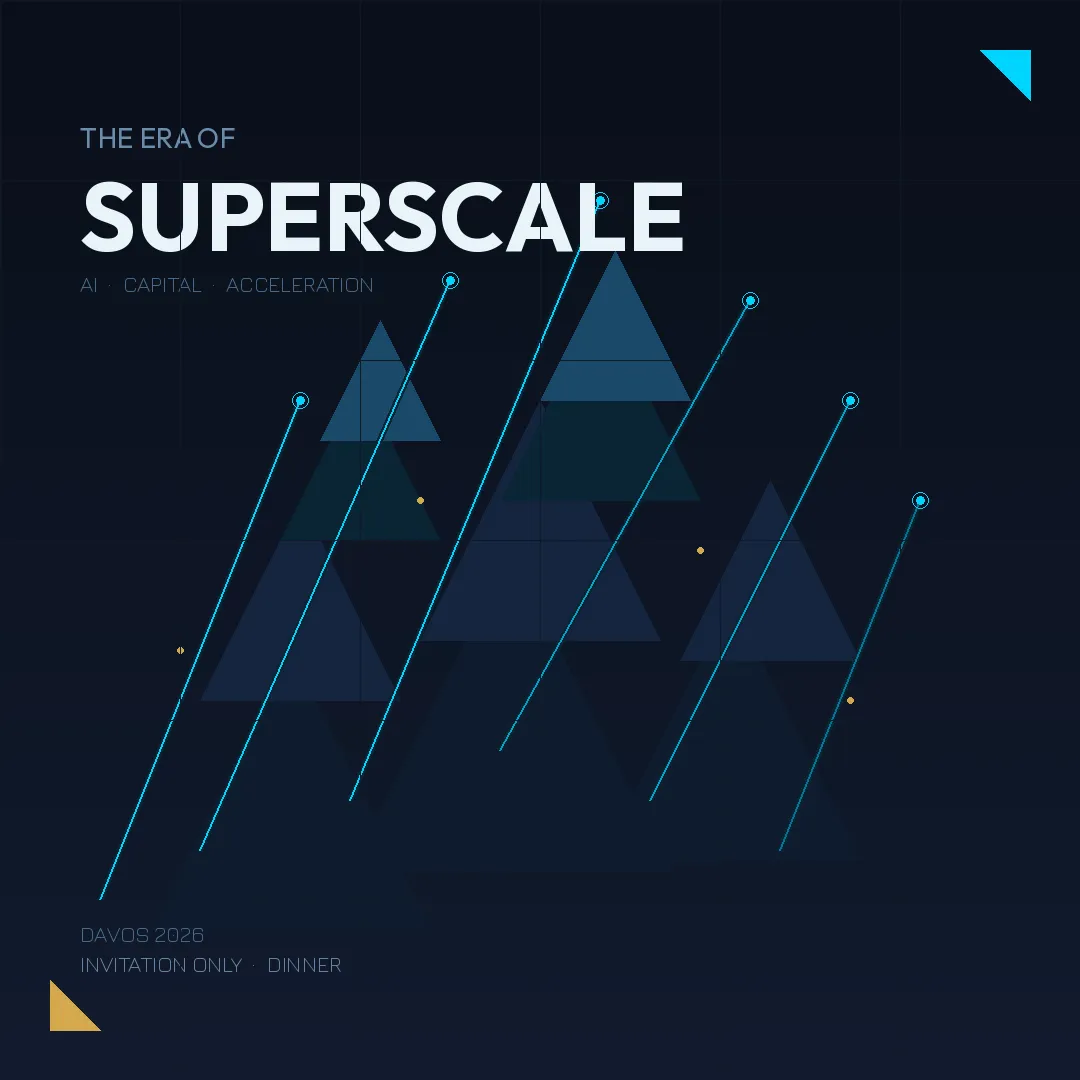
A new generation of companies will scale faster than anything before. AI compresses timelines. Robotics rewrites unit economics. New ways of thinking—what we call REWIRE—challenge assumptions about how organisations grow, who does the work, and what infrastructure is required. At the same time, hundreds of billions in early-stage capital sits trapped in private markets, waiting for liquidity that traditional exits can no longer provide. Secondary markets are emerging as the unlock—freeing risk capital that wants to stay at risk, recycle faster, and back the next wave.
This dinner brings together a select group of investors with track records across early and late stage, founders building scale-up companies, and invited guests shaping capital flows and policy. We ask: how do we accelerate SuperScale—and how does Davos as a platform help propel it?
Dinner will be served. And we will be joined by Rory Bremner—Britain's sharpest satirist and impressionist, with a repertoire of over 100 voices from presidents to prime ministers, Davos regulars to global personalities. Winner of multiple BAFTAs for political satire, Rory brings the room alive—and a few familiar faces into it.
Convened by Mark Turrell, WEF Technology Pioneer (2008) and Young Global Leader (2010), founder of unDavos—the working summit of Davos Week, now in its 15th year bringing together leaders who build, invest, and ship.
Application required. Action expected. This is not a broadcast event—it is a working dinner for those actively building or backing what comes next.
Gaming at the Frontline of Human Connection: Trust, Wellbeing and Healthy Play in a Changing Tech Landscape
Gaming has become one of the most important social spaces of our time, a place where young people learn, connect, collaborate and build identity. As technology continues to evolve, games increasingly shape how people build skills, experience wellbeing and form meaningful connections. At the same time, gaming environments are exposed to a wide spectrum of cyber threats—from account compromise, fraud and AI-enabled manipulation to cyberbullying, harassment, grooming and other forms of online predation—each with direct implications for mental health and healthy participation.
This panel explores how gaming can be intentionally designed as a positive force for human development, focusing on healthy gameplay, trust and wellbeing. While new technologies play a growing role in how games are built and moderated, the discussion centres on the human outcomes that matter most: learning, resilience, belonging and responsible engagement.
Bringing together perspectives from across industry, education and advocacy, the session will examine how collaboration and shared responsibility can help ensure gaming environments remain safe, enriching and future-ready, while preserving the joy, creativity and community at the heart of play.
Highlighting enabling factors such as a high-potential demographic, abundant natural resources, and the continental free trade agreement, among others. This panel is a conversation with influential Africans utilizing media, policy, and advocacy to shape constructive narratives, challenge misconceptions, and represent Africa's diverse strengths and aspirations.
Championing African diaspora-led entrepreneurship and cutting-edge innovation. This panel showcases African-diasporan entrepreneurs who are actively implementing tangible projects across sectors to foster sustainable growth and resilience on the continent.
Join us for an exclusive, closed-door conversation on how capital for the space sector is being unlocked across public and private markets. This panel convenes senior leaders including Aarti Holla-Maini, Director of UNOOSA; Madin Maseeh, President of the MSRO; and Hannah Ashford, Managing Director of The Karman Project, alongside a leading multi-space platform following a USD 50 million raise for SIDS. Moderated by Rajeeshwaran Moorthy, a prominent space investor and institutional capital advisor, the discussion explores frontier financing models, public–private collaboration, and the capital structures the space economy needs next.
MoU Signing ceremony - strictly invited guests only.
MoU Signing ceremony - strictly invited guests only.
Seeing Africa as a frontier for profit, not just a recipient of aid. The experts of this panel dive into the role of foreign and diaspora-led Venture Capital and Private Equity, and how to navigate cross-border complexities and regulatory "bridges."
An interactive session designed for deep, meaningful connections. Participants will engage in curated discussions to generate new ideas, explore collaboration opportunities, and identify actionable follow-up steps.
Join a private, investor-focused Q&A with physicist Nassim Haramein to explore a fundamental energy breakthrough nearing commercial application.
Haramein’s forthcoming book UNIFIED proposes a solution to the unified field theory, laying the scientific foundation for a new class of scalable energy systems. This closed-door session is designed for investors seeking early insight into frontier technologies before broad market exposure.
Discussion will cover:
• The scientific basis behind UNIFIED
• Implications for scalable, investable energy systems
• A breakthrough energy technology approaching commercial readiness
See UnifiedTheBook.com.
Q&A facilitated by Dr David Rock
🗓 Thursday 22 January | 2:30–3:30pm
📍 Davos
🎟 Limited seating — priority to investors, family offices & energy professionals. Attendance upon approval.
📞 Inquiries: Dr. David Rock — +1 (646) 238-3769
Cannot attend this session? Join our next virtual investor session on January 29: https://luma.com/f0yiefoh

During Davos Week 2026, the Permanent Mission of Sri Lanka in Geneva, together with the Swiss Asian Chamber of Commerce (SACC), has the honour to host a private, invitation-only breakfast briefing with
The Honourable Dr. Harini Amarasuriya, Prime Minister of Sri Lanka, and
The Honourable Dr. Anthonige Anil Jayantha Fernando, Cabinet Minister of Labour and Deputy Minister of Finance & Planning.
The briefing will convene a small and carefully curated group of senior participants and is convened by SACC as a Private Address within the unDavos Summit, under the theme:
Economic Policy Vision for Sri Lanka:
Competing through Priority Sectors and Investment Attraction
The format is designed to provide a discreet and structured setting for substantive dialogue between senior government leadership and international stakeholders, with controlled visibility and strict access management in line with ministerial protocol.
Discussion Focus
The briefing will address:
Sri Lanka’s economic policy direction and reform agenda
Priority sectors and investment opportunities
Developments in financial services, capital markets, and the services sector
Topics of relevance to international investors and strategic partners
Participation
Participation is by invitation only and subject to confirmation.
SACC Members: CHF 50.–
Non-Members: CHF 75.–
Kindly confirm your participation by RSVP no later than Tuesday, 20 January 2026, at
Warm Data Labs are a kind of high-altitude campfire. 🏕️ Expect stories, moments of resonance, unexpected insights, and the kind of learning that can only happen across contexts. When we pay attention to our senses, our relationships, and the liminal space between perspectives, something subtle shifts. New collective perceptions begin to surface.
We’re living in a time of increasing complexity and overlapping crises—climate, culture, capital, meaning. The invitation is not to "solution", but rather, to listen differently. To sense together. To improvise at the edge of what we think we understand. On this magic mountain, the capacity to respond doesn’t live in expertise alone. It emerges when people gather with curiosity, presence, and a willingness to relate in new ways—when we slow down enough to notice how the world assembles itself differently in each of us.
An inspiring address from an African visionary celebrating the transformative power of the global African community and its crucial role in continental development.
Welcome from the co-founders of PACHEDU, introduction to the program, and thank yous.
Entertainment is fragmenting and expanding simultaneously. Documentaries move markets and shape public opinion. Creators with phones outperform studios with budgets. Gaming isn't a niche—it's a $200 billion industry where esports athletes fill stadiums and streamers command audiences larger than cable networks. The gatekeepers are gone; distribution is direct; and the line between player, viewer, and creator keeps blurring. This session examines who's building the next generation of entertainment, where capital is flowing, and what "mainstream" even means anymore.
Entertainment is everywhere—and it's doing more than ever. A 60-second TikTok teaches global economics. A Netflix documentary sparks a movement. Podcasters build audiences bigger than cable networks. Creators bypass studios entirely and thrive. Gaming communities gather millions to watch, learn, and connect. The best content now entertains, educates, and informs all at once—and audiences are more engaged than ever. This panel explores how social media, streaming, and emerging formats are reshaping storytelling, influence, and culture. We bring together creators, platforms, and investors to examine who's winning attention, what formats are working, and where entertainment goes next.
Those who control data control the future of AI.
Yet data, the most valuable resource on earth, sits on zero balance sheets.
Invisible. Untradeable.
Not because it lacks value—but because it lacks regulatory-compliant infrastructure.
$16 trillion in tokenized assets by 2030. Real estate, bonds, commodities—all flowing on-chain.
But data? The resource powering trillion-dollar AI companies has no ownership layer, no price discovery, no market.
That is changing now.
In this talk, Gregor Žavcer, co-founder of Ethereum Swarm and Datafund, explores why data is the next frontier for institutional-grade Real World Assets (RWA)—and why the window for first movers is measured in months, not years.
The session examines how AI agents are becoming the new market makers—requiring machine-readable ownership, machine-speed settlement, and data they can license autonomously.
It connects the rise of autonomous systems, the financialisation of intangible assets, and the emergence of data as a tradeable instrument into a single thesis: data tokenization is not theoretical. The rails are built. The first implementations are live.
Participants will gain a strategic view on how to position for the emerging data economy—and how to turn invisible assets into real value before the regulatory frameworks crystallize.
---
Key Themes & Questions Explored
- Why data remains invisible on balance sheets—and what changes that
- AI agents as autonomous market participants requiring data ownership
- Data tokenization as infrastructure, not speculation
- The separation of ownership and access as the key unlock
- Why first movers will shape the regulatory frameworks
- How to identify and unlock the value of data assets
---
Who Should Attend
- Investors and allocators exploring alternative assets
- AI and data infrastructure builders
- Enterprises and institutions with valuable data assets
- Policymakers and regulators shaping digital asset frameworks
- Anyone positioning for the next phase of the data economy
---
Why This Session Matters
Because the future of AI will not be decided by models alone.
It will be decided by who controls the data—and how that data is owned, traded, and governed.
Crypto fraud is no longer a niche problem - it’s industrialized.
Attackers leverage AI, Automation, and Fraud-as-a-Service to exploit Identity Leaks and onboarding weaknesses at scale. Attackers now scale faster than legitimate businesses.
At the same time, new data shows Impersonation Fraud has surged by over 1,000% in the past year, and criminal activity linked to Stablecoins - once seen as a stabilizing force - are now a primary vehicle for illicit flows, according to the latest Chainalysis reports. These trends are reshaping risk, compliance, and trust across the digital asset ecosystem.
In Davos, we bring together voices from Identity Innovation, Global Financial Crime Policy, and Blockchain Analytics to move the conversation beyond “cyber” and into economics: How do we reduce the hidden growth tax of fraud and compliance friction - and design architecture for secure, scalable growth?
Key words are: Smarter Compliance, Interoperable Identity Frameworks, and Architectural Redesign that can turn trust into a competitive advantage.
Expect actionable insights, forward-looking strategies, and a candid discussion on what leaders must unlearn to thrive in the next wave of digital growth.
What You’ll Learn
Why traditional controls fail against AI-driven fraud—and what works in 2026.
Latest insights from Chainalysis: stablecoin-driven crime, sanctions, scams, and ransomware trends.
From “verify again” to reusable identity/KYC and event-driven security—practical design choices that boost conversion and reduce risk.
Speakers
Denisse Rudich – CEO, Rudich Advisory (Financial Crime Policy & Sanctions)
Raido Saar – Founder, ComplyOnce (Digital Identity & Compliance Innovation)
Matthias Bauer-Langgartner – Head of Policy Europe, Chainalysis (Blockchain Analytics & Regulation)
Georg Harrer - Co-CEO, Bybit EU (Industry Expert)
Magnus Jones - Board Member / Founder, Nordic Blockchain Association (All Crypto, Compliance & Digital Identity)
Audience
C-level, Start-ups, CASPs/VASPs, Compliance and Risk Leaders, Policymakers, Investors, and Platform Executives scaling digital growth in 2026.
Kick off Davos with Welcome Drinks at the J-Hub, the Nexus of Mindful Leaders - an informal gathering designed to bring people together at the very start of the week. Join fellow leaders, family offices, tech pioneers and innovators for relaxed conversation over drinks, setting the tone for meaningful connections and energizing discussions ahead. It’s the perfect way to ease into Davos, reconnect with familiar faces, and spark new ideas before the week unfolds. 🍸
Space is limited and guests are admitted on a first-come, first-served basis. We recommend arriving early.
To register for additional events, explore our J-Hub event lineup here.
This event is co-organized by:
Penny Low, former Member of Parliament of Singapore, Founder and President of Social Innovation Park, WEF Young Global leader
Elisabetta Jiang, Co-Founder of Unicorns for Good, WEF Global Shaper
Seamon Chan, Founding Partner of Palm Drive Capital
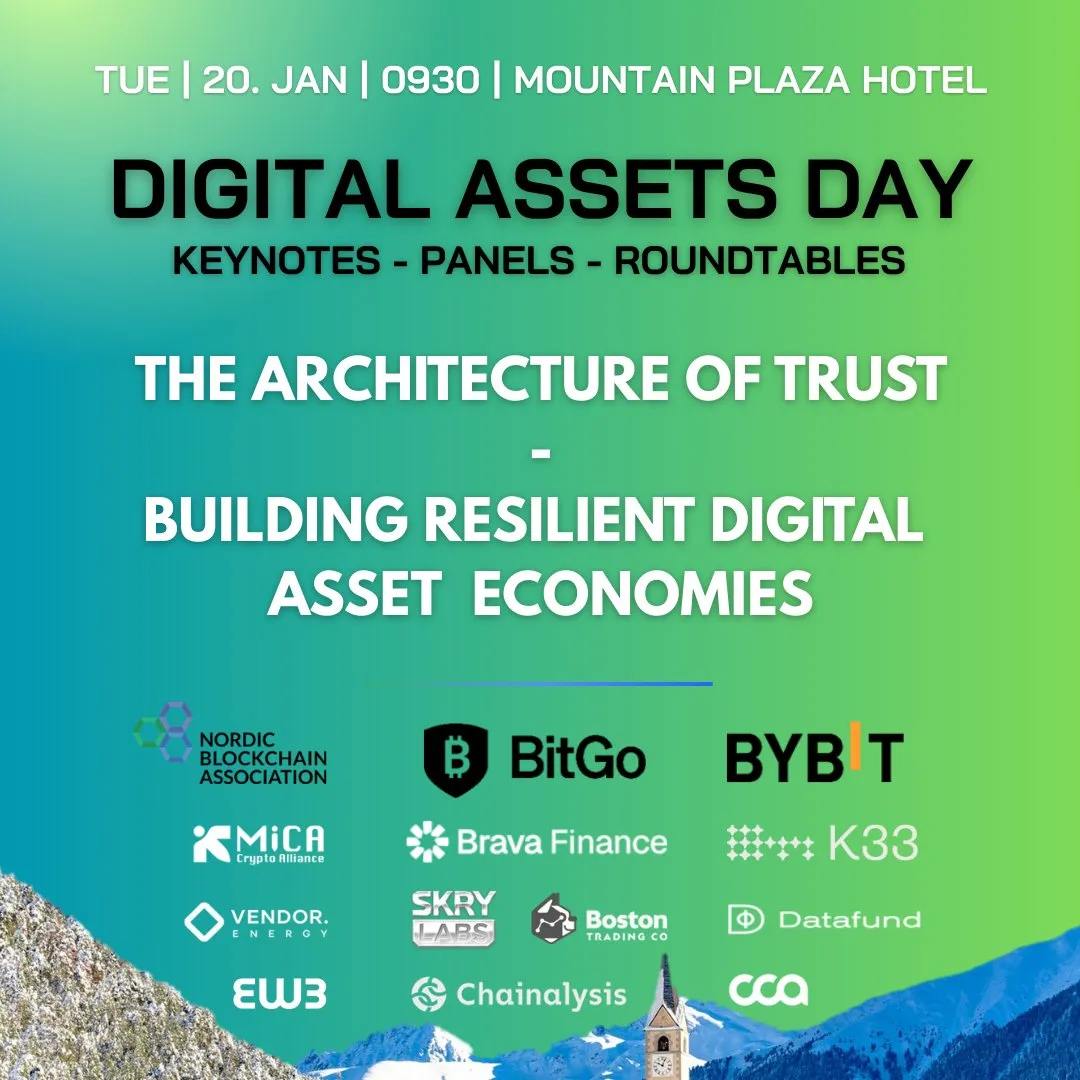
As Digital Assets move from speculation to infrastructure, trust and verification becomes the foundation for resilience and growth.
This thought leader session brings together four high-impact talks and presentations exploring how architecture - not patchwork - will define the next phase of Digital Economies.
From Energy Access and Institutional Bitcoin & Digital Asset Adoption to Fraud Prevention and Data Tokenization, these talks offer strategic insights for leaders shaping the mechanisms of the future of finance, infrastructure, and technology.
The talks will be followed by a Networking Break and a Roundtable starting 11:45 which you may signup for here: https://luma.com/x665z85c
Join Nordic Blockchain Association and partners for a Digital Assets Day - Building Resilient Digital Economies.
09:30 KEYNOTE – Tokenizing Access to Scarce Capacity: RWA × EU Energy Crisis × Infrastructure
Vitaly Peretyachenko | VENDOR.Energy |Co-Founder
Europe’s energy challenge is not about shortage—it’s about access. This keynote reframes the energy crisis through Real World Assets as systems of access control, not speculation. Learn why protocol-level governance is becoming essential for infrastructure resilience and long-term capital alignment.
09:50 PANEL – The Other Side of Growth: Navigating Crypto Scams, Fraud & Financial Crime
Crypto fraud is industrialized. AI-driven scams and fraud-as-a-service scale faster than legitimate businesses, while stablecoins dominate illicit flows. This panel explores how smarter compliance, interoperable identity frameworks, and architectural redesign can turn trust into a competitive advantage.
10:35 KEYNOTE – How Institutions Build Profitable Bitcoin & Token Strategies
Torbjørn Bull Jenssen | K33 | CEO
Bitcoin is moving onto institutional balance sheets. This session dives into practical strategies for banks, family offices, and professional investors—from custody and compliance to treasury exposure and product design—offering a roadmap for profitable, compliant adoption.
11:05 KEYNOTE – Data × AI × Tokenization: The Asset Class That Doesn’t Exist Yet
Gregor Žavcer | Datafund | Co- Founder
Data powers AI but sits invisible on balance sheets. This keynote examines how tokenization is unlocking data as a tradeable asset class, why AI agents will become autonomous market participants, and how first movers can shape the regulatory frameworks of the emerging data economy.
11:30 Networking Break
11:45 ROUNDTABLE - Tokenisation as the Backbone of Next-Generation Financial Infrastructure
Tokenisation is moving from concept to core infrastructure. This roundtable examines how tokenised assets can modernise capital markets, payments, and cross-border finance—while preserving trust and regulatory oversight. Join policymakers, institutions, and innovators for a high-level dialogue on building the foundations of tomorrow’s financial system. The Roundtable is brought to you in partnership with Bybit. Please sign up here: https://luma.com/x665z85c
14:00 Networking
Who should attend
C-level, CASPs/VASPs, Institutional investors, Policymakers, Compliance Leaders, Digital Asset Strategists, Crypto Stakeholders, Infrastructure operators, and Innovators shaping the next wave of Digital Economies.
Davos Film Festival is an invite-only film festival hosted annually during World Economic Forum in Davos, Switzerland.
2026
BAIMA - Documentary Premiere
When "dance is life," everything moves in harmony with the universe. Rodrigo Baima, raised in a favela, finds in dance a way to escape violence and creates an ecological performance inspired by Indigenous and Afro-Brazilian roots. For Luana, Wesley, Johnatan, and Rian, who come from families marked by extreme violence, joining the show is their only "way out of hell." Baima follows the journey from an idea born in the Amazon to selections and rehearsals, leading to a European tour that takes 25 young dancers from Cannes to a meeting with Pope Francis, before returning to the favela with dreams turned into reality.
WINE & CHEESE - Networking
Enjoy local wine and cheese from the Dolomites region of Italy, while immersing into a special art gallery.
OPEN DOORS - Art Exhibition
The Open Doors photography exhibition, born from the vision of Emotions to Generate Change by Lia and Marianna Beltrami and Ali Aksu, in collaboration with the Dicastery for Communication of the Holy See, is a journey through suspended moments—captured from diverse perspectives, yet woven together by a single truth: when doors open, reality is illuminated with new possibilities.
Twenty-five images unveil the mystery and beauty of what unfolds when access is free, when thresholds are not barriers but bridges. It is the path of the pilgrim of hope, passing through doors flung wide open to humanity and eternity—doors that welcome, reveal, and transform.
Each photograph is a testament to authenticity, imbued with the gaze and intelligence of nine passionate artists: Nese Ari, Asaf Ud Daula, Raffaele Merler, Pierluigi Meduri, Gustavo Ten Hoever , Marianna Beltrami, Chiara Caprettini, Rodrigo Baima, Simone Risoluti. Through their sensitive eyes, we embark on a journey across distant worlds—from Turkey to Wales, from Italy to Bangladesh, from India to Morocco, reaching Benin, Brazil, the Vatican, and the eternal peaks of the Dolomites. The exhibition supports are crafted by the Autonomous Province of Trento, designed by Sabrina Camin and Claudio Marconi, using reclaimed wood from the storms that swept through the Dolomites.
Yet, the emotions captured in these frames do not remain still. They move, take root, and become seeds of transformation. Some of the faces within these images are not mere subjects but witnesses and protagonists of real change. Like Rodrigo and his group of young visionaries, who in the favela of Marcos Moura, Brazil, are reshaping the future through a path of ecological and social renewal.
Pope Francis, through the power of his life and teachings, opens the doors of hearts and invites us to cross them without fear. Not with empty words, but with concrete actions. Not with silent images, but with visions powerful enough to stir the soul.
The exhibition opened in the Vatican on March 25, 2025, and was then presented in various dioceses around the world, in Verona at La Gran Guardia Palace and in Trento's Piazza del Duomo in October.
For 30 years, software has systematically dismantled the cost, friction, and latency of every major system of coordination—media, commerce, logistics, communications. Money is the exception. Despite a fully digital economy, finance still operates on batch settlement, fragmented ledgers, delayed reconciliation, and jurisdictional silos.
This session explains why money resisted digitisation longer than any other layer—and why that resistance is now collapsing.
Stablecoins are not a new asset class; they are the native digital form of cash.
Always-on, programmable, and globally interoperable, they collapse payments, treasury, savings, and short-term credit into a single financial primitive.
Once money becomes software, capital markets follow.
Tokenised credit and assets enable continuous settlement, real-time risk management, and radically more efficient capital allocation.
This is not a speculative future or a regulatory thought experiment. It is a structural shift already underway, driven by utility, scale, and economics.
The discussion focuses on what changes when money finally digitises—and why this transition will underpin the next phase of global financial infrastructure.
Join Nordic Blockchain Association and Brava Finance for a discussion on the mechanisms of the future of finance - that is already here.
The Panel is part of the Digital Asset Program at the unDavos Summit and this session will be followed by a related Roundtable:
Beyond MiCA: Stablecoins, Infrastructure & the GENIUS Era
Signup for the Roundtable here: https://luma.com/r9az25rl
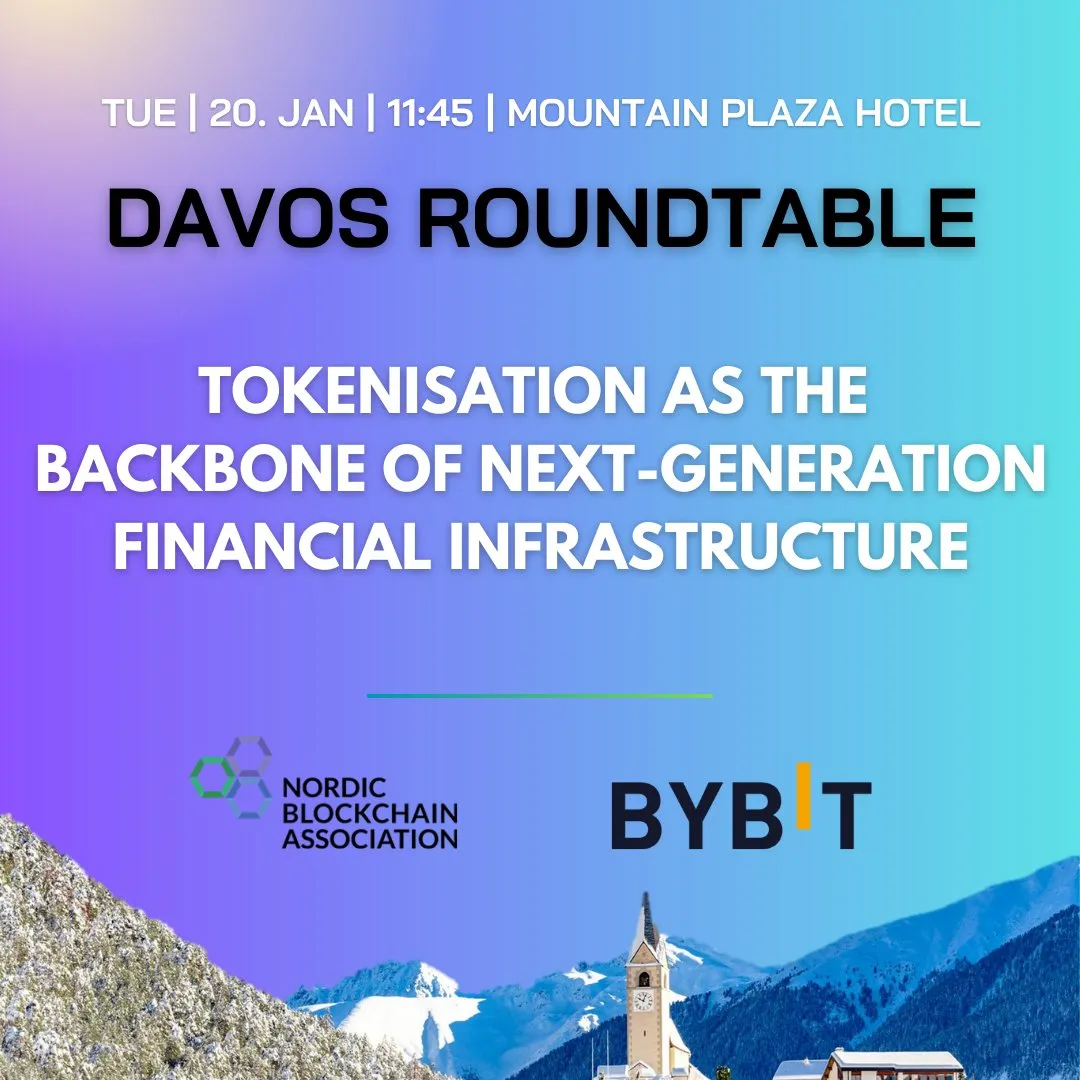
Tokenisation is moving from experimentation to deployment.
Financial infrastructure is evolving to meet the demands of a Real-time, Digital, and Globally connected economy.
Decisions taken today will shape whether it becomes a fragmented overlay or a foundational layer of Global Financial Infrastructure.
Tokenisation enables Assets, Rights, and Obligations to be represented natively in digital form, allowing for Programmable Settlement, Embedded Compliance, and Improved Interoperability across markets.
This Roundtable explores Tokenisation not as a product innovation, but as core Financial Infrastructure - with the potential to modernise Capital Markets, Payments, and Cross-border Finance while preserving trust, stability and regulatory oversight.
Join us for an in-depth discussion brought to you by Nordic Blockchain Association in partnership with Bybit.
We will facilitate a high-level dialogue between policymakers, regulators, financial institutions, and infrastructure providers on how tokenisation can be safely and responsibly integrated into next-generation financial systems.
Some key questions to be addressed:
Where does tokenisation deliver clear infrastructure-level benefits over legacy systems?
How should tokenised infrastructure coexist with traditional financial rails?
What regulatory approaches best support scalable, institution-grade adoption?
How can interoperability be achieved across jurisdictions and market structures?
What are the risks of delaying financial infrastructure modernisation?
The Roundtable is relevant for C-level, Banking/Finance, CASPs, Asset managers, Investors, VCs ETF players, Stablecoin issuers, Exchange risk/compliance leads, Policy makers, Fintech counsel and other stakeholders interacting or planning to interact with Digital Assets.
Weather you are curious to understand how Digital Assets will affect finance functions of your industry, or you are a Digital Asset expert. You are all welcome to join to discuss how Digital Assets will affect the economy in 2026.
Chatham House rules apply.
The Roundtable will be led by Magnus Jones from Nordic Blockchain Association and Georg Harer from Bybit, accompanied by experts from public and private sectors .
As the demand for quality healthcare surges in low- and middle-income countries yet global aid dollars decrease, how do we meet this moment in ways that protect human health, support local economic growth and leverage the best of cross-sector collaboration?
In this moderated fireside chat, the leaders of Hilleman Labs (joint venture backed by Wellcome and MSD) and CEPI discuss how true ecosystem partnerships across the whole value chain work together to advance much- needed vaccines while creating skilled jobs and driving local prosperity.
As part of this discussion, a new strategic partnership will be announced that points the way toward a transformative shift in the way that we meet emerging health threats and foster market growth in low- and middle-income countries.
Bitcoin is moving onto institutional balance sheets and into client portfolios.
The real question is no longer if, but how to do it in a profitable and compliant way.
In this keynote, Torbjørn Bull Jenssen, CEO of K33, shares hands-on experience from working with Banks, Family Offices and Professional Investors across Europe.
At K33.com, we build and operate institutional-grade Bitcoin and Digital Asset services, from Brokerage and Custody to Treasury solutions and Market Intelligence.
The session covers how institutions implement Bitcoin and selected Token Strategies in practice. This includes treasury exposure, product design, custody and compliance, pricing models, client segmentation and partner selection.
Torbjørn also shares his current view on the Bitcoin market, the drivers behind institutional momentum, and how decision-makers should think about risk and return.
This is a hands-on deep dive practical session for decision-makers ready to move from discussion to execution.
Europe is not facing an energy shortage - It is facing an access crisis.
As electrification accelerates and geopolitical pressure reshapes supply chains, energy infrastructure is reaching its physical and regulatory limits.
Capacity is scarce. Deployment is slow. Allocation is no longer governed by markets alone, but by priorities, constraints, and institutional decisions.
This session reframes the energy crisis through a new lens: Real World Assets not as financial instruments, but as systems of access control to scarce infrastructure.
Vitaly Peretyachenko, founder of VENDOR.Energy™, explores why energy is becoming the most consequential frontier for institutional-grade RWA — not through tokenizing energy itself, but by structuring who gets access to deployable capacity, when, and under which rules.
The session examines how physically bounded, certifiable energy infrastructure creates natural points of scarcity — and why these points demand protocol-level governance rather than contracts, discretion, or speculation. It connects energy resilience, infrastructure security, and digital asset frameworks into a single narrative: scarcity creates queues, queues require rules, and rules increasingly require protocols.
Participants will gain a strategic view on how access, capacity registration, and execution discipline are reshaping the future of energy infrastructure — and why this shift matters not only for markets, but for safety, sovereignty, and long-term capital alignment.
⸻
Key Themes & Questions Explored• Why energy has returned as a strategic bottleneck for Europe
• Why markets fail when infrastructure becomes scarce
• RWA as access control, not asset speculation
• Capacity registration as the anchor of institutional trust
• Infrastructure resilience as a new layer of safety
• How regulation and physics quietly shape the future of digital assets
⸻
Who Should Attend
• Infrastructure & energy investors
• Policymakers and regulators
• RWA and digital asset strategists
• Utilities, grid operators, and industrial leaders
• Sovereign, institutional, and long-horizon capital
• Anyone shaping — or governed by — the future of energy access
⸻
Why This Session Matters
Because the next phase of the energy transition will not be decided by technology alone.
It will be decided by who controls access to scarce infrastructure — and how that access is governed.
Healthcare is shifting from fixing illness to designing wellbeing. What happens when AI meets care, prevention, and human dignity? This panel explores the systems needed for longer, healthier, more humane lives.
Global Leaders on Power, Responsibility & Direction Big systems don’t shift by accident. Global leaders reflect on how policy, capital, and long-term vision can align — and what it really takes to steer society toward a thriving future.
+ Book Presentation "The Shift"
In complex systems, certainty is dangerous. This session explores leadership not as control, but as the courage to question assumptions, challenge defaults, and create space for real change.
In a world far from equilibrium, systems driven solely by growth tend
toward collapse. Drawing on the insights of Gregory Bateson, Donella
Meadows, and Humberto Maturana, this presentation explores how
systems can regain stability through balancing feedback loops, the often-
overlooked forces that restore coherence.
We will examine how meaningful change arises not only from new
strategies or technologies, but from reconnecting lost information,
rebuilding relationships, and reinforcing reciprocity. We will also reflect
on why change so easily disappears, and how it can be sustained by
embedding it in durable patterns, narratives, and culture.
Through practical examples, conversation and interactive exercises, we
explore how to recognize and connect “islands of coherence,” and how
these small practices are already shaping a larger living pattern.
System Shifters Unite! Everyone wants collaboration. Few systems actually support it. This session dissects why collaboration breaks down — and how to redesign incentives, structures, and trust so collective impact becomes possible.
Narratives shape both history and future. In this session you will experience the Power of Positive Polarization. This is not a panel discussion, but a revealing way of having courageous conversations. An active, participatory format that challenges assumptions and invites real dialogue. The time for hiding is over. Be part of the solution. Be part of the conversation. Be part of the narrative of change. Dare to shift.
The conversations don’t end here. They begin — over drinks, new connections, and the shared commitment to turn microshifts into macro impact.
Biodiversity is not a “nice to have” — it’s the operating system of life. From regeneration to biomimicry, this panel explores how nature already holds the answers — if we’re willing to design with it, not against it.
17:45 - 18:45
Future of Collaboration: Designed to Fail: Why Collaboration Never Scales — and How to Fix It
Everyone wants collaboration. Few systems actually support it. This session dissects why collaboration breaks down and how to redesign incentives structures and trust.
19:00 - 20:00
Leadership between Panic and Promise
Narratives shape both history and future. In this session you will experience the Power of Positive Polarization. This is an active participatory format that challenges assumptions.
20:00 - 21:00
Closing & Drinks
The conversations don't end here. They begin over drinks new connections and the shared commitment to turn microshifts into macro impact.
What if the real shifts aren’t loud revolutions, but quiet changes beneath the surface? We open the day by naming what’s already moving — and why now is the moment to act.
09:30 - 09:45
Welcome to the Shift Beneath the Surface
What if the real shifts aren't loud revolutions but quiet changes beneath the surface? We open the day by naming what's already moving and why now is the moment to act.
09:45 - 10:45
The future of AI: Who shapes reality? - AI Is Not Neutral — So Who Gets to Decide?
How do we build trust in AI when it increasingly influences what we see and how we decide? In this panel we explore how AI is reshaping trust in media politics business and amongst people today and how a safe and trustworthy future can be secured.
10:45 - 11:00
Creating space for Continued Conversations Elsewhere
(yes, that means coffee!)
11:00 - 12:00
CPR for the planet: Biodiversity & Regeneration in the age of AI - Nature Is the Ultimate System Designer
Biodiversity is not a nice to have it's the operating system of life. From regeneration to biomimicry this panel explores how nature already holds the answers.
12:00 - 12:45
Lunch Break
REGISTER HERE: https://theshift.now/events/events/davos/sign-up
How do we build trust in AI when it increasingly influences what we see and how we decide? In this panel, we explore how AI is reshaping trust in media, politics, business and amongst people today and how a safe and trustworthy future can be secured, including the capabilities leaders and institutions need to make responsible AI work in practice.
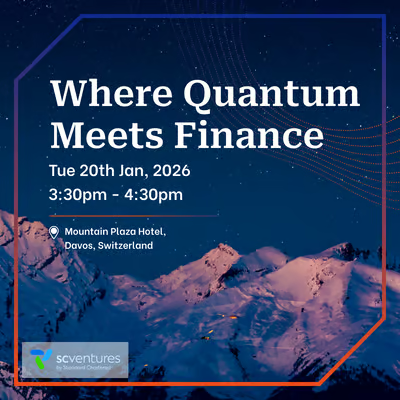
Quantum foundations, exponential outcomes
How frontier tech is re-shaping finance with collaborative innovation.
Host / Speakers:
Steve Suarez — CEO HorizonX
Alex Manson — CEO Standard Chartered Ventures
Vishal Shete — Co-Founder and CEO (Stealth Venture)
Robin Slakhorst - Partner & Co-Owner, WeTrust Capital
In our panel we will cover:
How new ventures harnessing frontier technologies have repeatedly re-shaped industries like Finance & corporates at the forefront have often reaped the rewards
How collaboration has repeatedly been the key driver for step change in tech innovation
Application areas in finance where value can be harnessed today & where upcoming risks need to be addressed
Outlook for the growth of quantum technologies, the scale of change that will be unlocked as this technology matures and the forecasted timing of technology progress
Event Details:
Date & Time: Tue 20th Jan, 3:30pm - 4:30pm
Location: Mountain Plaza Hotel, Davos Switzerland.
We are entering a new era where artificial intelligence is rewriting the rules of business. AI is not just another technology—it is a force that will redefine industries, reshape work, and recast the role of leadership itself. In this talk, Vijay Gurbaxani explores the opportunities and risks of this transformation, drawing on striking examples of how AI is already reshaping companies and society. He challenges leaders to think differently about value, competitiveness, and the choices that will determine whether their organizations thrive or fall behind. The transformation flywheel provides a comprehensive framework for the journey ahead. This is a moment of extraordinary promise—and peril. The decisions executives make today will shape the future.
Senior leaders from leading organisations share where AI is already delivering results. From automation to agentic workflows, this session focuses on real deployments, hard-earned lessons, and measurable impact — cutting through experimentation to show what truly scales.
This fireside chat marks the launch of the AI for Good Impact Report 2025, featuring a high-level conversation on the current state and future trajectory of AI. The discussion will examine emerging technologies such as generative and agentic AI, as well as evolving regulatory and governance approaches at regional and global levels. Building on the report’s findings, the exchange will highlight AI applications across key sectors including health, education, environment, infrastructure, and agriculture, while addressing challenges related to ethics, inclusion, privacy, workforce transitions, and sustainability.
AGI-level capabilities will redefine what organisations can become. This closing session looks beyond today’s constraints to explore new forms of enterprise, scale, and human potential in an era of near-limitless intelligence.
Artificial intelligence, XR, robotics, and clean energy are not just accelerating change. They are collapsing long-standing assumptions about work, growth, power, and governance. This talk challenges the comforting belief that tomorrow will look like a faster version of today. It will not. The technologies arriving this decade reshape institutions, labor, capital, geopolitics, and social contracts in ways unlike prior industrial revolutions.
Drawing on data, real deployments, and policy insight, this session explores both the upside and the risks: abundance or instability, cooperation or fragmentation. Most importantly, it focuses on action. What leaders must rethink now inside organizations, markets, and governments to avoid being reactive later. The choices made in the next few years will define prosperity, stability, and dignity for generations to come.
Technology is reshaping geopolitics in real time. AI leadership is contested between superpowers. Robotics is rewriting manufacturing and labour markets. Emerging technologies are creating new dependencies, vulnerabilities, and strategic leverage. This interactive session uses structured inquiry to cut through the noise—posing hard questions, surfacing assumptions, and building toward actionable insights. No panels, no lectures. Participants work together to map the landscape, identify blind spots, and define what decisions actually matter in the next 12 months. Come ready to think.
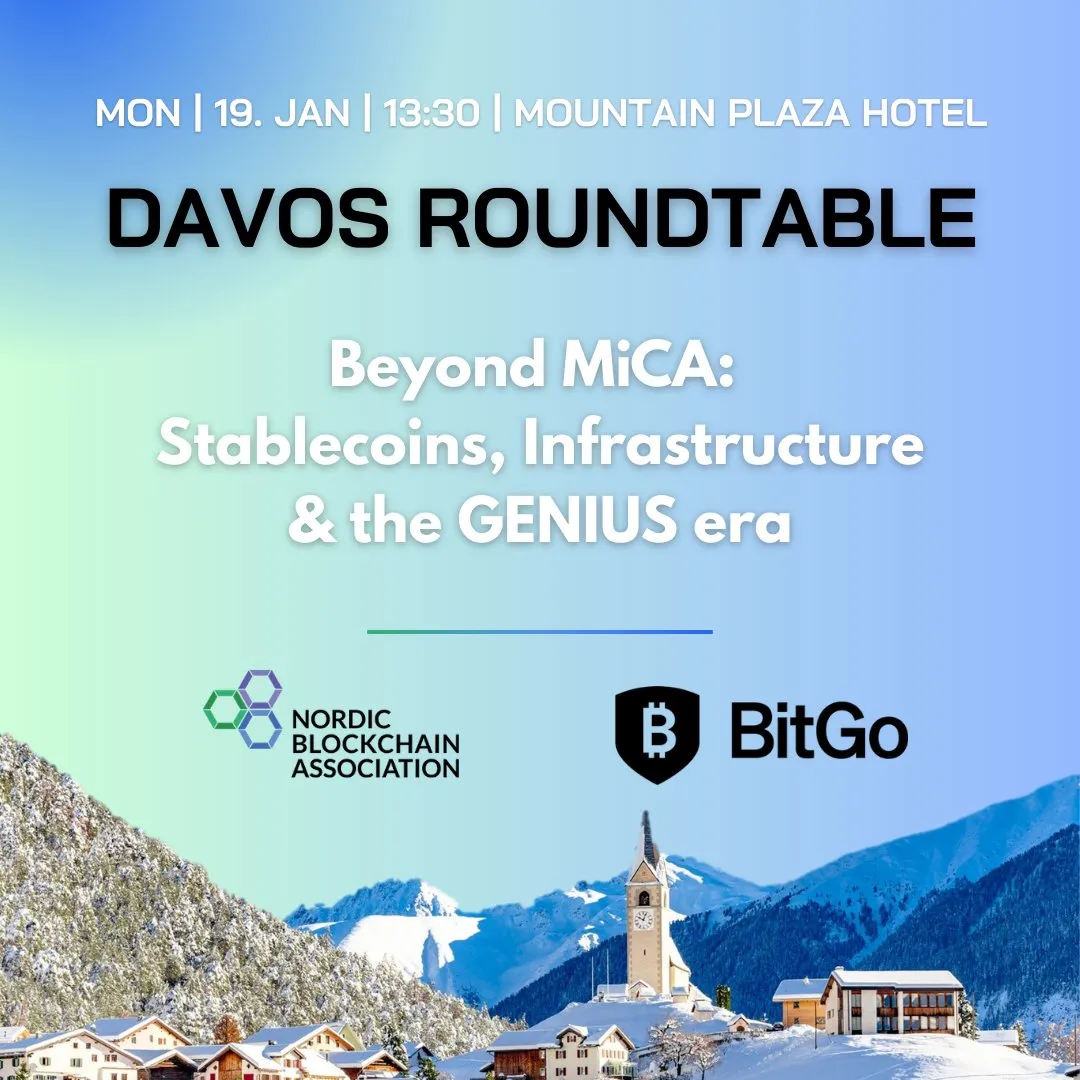
Institutional adoption now turns on regulatory clarity and custody architecture.
In the EU, the Markets in Crypto-Assets Regulation (MiCA) is fully live, re‑defining asset segregation and issuer obligations.
In the US, the GENIUS Act delivers the first federal framework for payment stablecoins with 1:1 reserves, monthly reporting and explicit BSA/AML coverage—creating a transatlantic convergence, but also some divergences that institutions must navigate.
Meanwhile, the UK is moving forward with a systemic stablecoin regime, and global supervision is tightening via FATF (Travel Rule) and the Basel crypto‑exposure standard.
Join us for an in-depth discussion at this roundtable brought to you by Nordic Blockchain Association in partnership with BitGo.
Together with experts from public and private side, we will unpack challenges as well as opportunities to be aware of in the 2026 landscape of Digital Assets.
A Global Macro Perspective, Stablecoins-as-a-Service, Qualified Custody, Wealth Management, ETFs, Staking, Settlement Networks, Policy and Regulations are key words.
The Roundtable is relevant for C-level, Banking/Finance, CASPs, Asset managers, Investors, VCs ETF players, Stablecoin issuers, Exchange risk/compliance leads, Policy makers, Fintech counsel and other stakeholders interacting or planning to interact with Digital Assets.
Weather you are curious to understand how Digital Assets will affect finance functions of your industry, or you are a Digital Asset expert. You are all welcome to join to discuss how Digital Assets will affect the economy in 2026.
Chatham House rules apply.
The Roundtable will be led by Magnus Jones from Nordic Blockchain Association and Brett Reeves from BitGo, accompanied by experts from public and private sectors .
In a world shaped by exponential technologies, systemic shocks, and unprecedented complexity, traditional leadership models are no longer sufficient.
This opening masterclass explores Quantum Leadership — the capacity to lead with clarity, coherence, and decisiveness when outcomes are uncertain and systems are constantly shifting.
Drawing on real-world executive experience at the highest levels, this session reframes leadership from control to calibration: how leaders set direction, stabilise organisations under pressure, and unlock performance in environments where cause and effect are no longer linear.
Why Attend:
Participants will explore how presence, precision, and strategic coherence become the true competitive advantages in a quantum era — and how leaders who master these capabilities shape not just organisations, but the future itself.
Who is this for:
Chairs, Principles, CEOs and Senior stakeholders navigating complex decision making in the AI Quantum driven world.
This session moves from narrative to action. We open by challenging outdated perceptions of Africa through media, policy, and advocacy voices. Then we showcase diaspora leaders actively building businesses on the continent—sustainable mobility, aviation fuel, fintech, gender-lens investing. The World Café turns conversation into concrete next steps: partnerships, investments, and commitments. You leave with contacts, ideas, and a clear action to take forward.

WCorp Ltd in partnership with Dandelion, invites global leaders to participate in Council, a simple practice designed to foster deep listening, build trust, and unlock collective wisdom. Two small groups of participants will come together for 90 minute sessions focused on exploring the future, reimagining leadership, and building for global impact. Join us to learn about Council, a core culture building practice at Snap Inc.
This experiential 90-minute workshop introduces Council, the circle practice Snap uses globally to amplify voices and unlock collective wisdom. Reimagining how we lead and collaborate requires spaces where all perspectives are heard, valued, and transformed into shared solutions.
Through facilitated circle experience, participants practice deep listening beyond reactive hearing, share authentic voice from the heart, and generate collective intelligence that transforms polarized opinions into breakthrough insight. Experience how structured dialogue surfaces solutions no individual could find alone—and how inclusive dialogue creates new architectures for leadership.
Leave with immediately applicable practices for building dialogue-forward culture where diverse experiences shape decision-making. Discover how Council shifts influence from top-down to all-in.
Please note that we ask you to arrive promptly and stay for the full 90 minute session in order to experience the full arc of Council.
RSVP Women-only Session at 9:05am
RSVP Joint Women & Men Session at 11:05am
Strictly Limited seats.
WCorp Ltd in partnership with Dandelion, invites global leaders to participate in Council, a simple practice designed to foster deep listening, build trust, and unlock collective wisdom. Two small groups of participants will come together for 90 minute sessions focused on exploring the future, reimagining leadership, and building for global impact. Join us to learn about Council, a core culture building practice at Snap Inc.
This experiential 90-minute workshop introduces Council, the circle practice Snap uses globally to amplify voices and unlock collective wisdom. Reimagining how we lead and collaborate requires spaces where all perspectives are heard, valued, and transformed into shared solutions.
Through facilitated circle experience, participants practice deep listening beyond reactive hearing, share authentic voice from the heart, and generate collective intelligence that transforms polarized opinions into breakthrough insight. Experience how structured dialogue surfaces solutions no individual could find alone—and how inclusive dialogue creates new architectures for leadership.
Leave with immediately applicable practices for building dialogue-forward culture where diverse experiences shape decision-making. Discover how Council shifts influence from top-down to all-in.
Please note that we ask you to arrive promptly and stay for the full 90 minute session in order to experience the full arc of Council.
RSVP Women-only Session at 9:05am
RSVP Joint Women & Men Session at 11:05am
Strictly Limited seats.
Sustainability, decarbonization, and the energy transition require deploying proven and emerging technologies at unprecedented scale. This panel explores selected innovations across hydrogen, solar, battery storage, synthetic fuels, and more, to examine what it takes to move from technical viability to globally relevant deployment.
Topics include how these solutions work, their contribution to decarbonization and a sustainable economy, key technical and commercial challenges, pathways to overcome them, and associated capital requirements. Infrastructure investors, technology providers, project developers, and corporates discuss pathways from pilot projects to gigawatt-scale impact.
The transformation toward a sustainable economy requires investment on an unprecedented scale, estimated at roughly USD 275 trillion over the coming decades. CleanTech and nature-based solutions face a well-documented capital gap between early-stage venture funding and large-scale deployment. Achieving net-zero targets by 2050 is expected to require approximately USD 6 trillion in additional investment per year .
This panel examines how public and private capital can be unlocked to bridge that gap, how shifting investment narratives, such as AI, defense, and changing global governance priorities, affect capital allocation, what cleantech investors are looking for today, and how nature restoration and conservation can be financed at scale.
Discussion topics include where capital is currently flowing and where it is constrained, who invests and why, which business models are proving bankable, how risks are assessed and mitigated, and how nature-based solutions can become investable. The panel focuses on later-stage venture, growth equity, pre-IPO capital, pathways to public markets, secondary liquidity, and capital-formation mechanisms that can help close the annual funding gap. Investors, capital-formation service providers, and investment bankers discuss the challenges of scaling and strategies to mobilize capital at the required scale.
ESG reporting has become standard for institutional investors, but frameworks vary and implementation differs across funds.
This panel examines how ESG reporting actually works—what frameworks dominate (TCFD, SFDR, ISSB), what data gets collected and reported, and how large asset managers integrate ESG into investment decisions. Topics include compliance versus strategic use of ESG data, how pension funds and sovereigns apply ESG mandates, what reporting requirements mean for portfolio companies, and where standardization is heading.
Institutional investors, asset managers, and reporting practitioners discuss operational reality versus aspiration.
This session brings together technology leaders, investors, and policymakers examining how innovation can drive the transformation toward a sustainable global economy, how this transformation is financed, and how its real-world impact is measured.
Across three focused panels, the discussion moves from deployable climate technologies, to capital formation and scaling, and finally to impact measurement and ESG reporting—bridging strategy, execution, and accountability.
Energy geopolitics has entered a new era—where security of supply, critical minerals, grids and infrastructure now shape alliances, competitiveness and national power as much as oil once did.
When AI brings answers, who brings the judgement? The value of professional services in the AI led world
In 2026, we’ve reached Peak Execution.
AI agents can now draft contracts, simulate 10-year market strategies, and generate high-fidelity brand identities in seconds. If the "output" is now a commodity, what value do companies pay professionals for? This session explores the transition from the Knowledge Economy to the Wisdom Economy.
We explore the value AI cannot replace.
Who this session is for
• C-level executives contracting professional services on a regular basis
• Professional services leaders, consulting firms heads shaping AI-resilient strategies
Our global challenges are not only failures of policy or economics, but the long-term consequences of centuries of epistemicide — the systematic erasure of sophisticated ancestral knowledge systems and sciences, leaving humanity governed by an epistemological monoculture and disconnected from the vast intelligence of the Living World.
This panel explores what it means, in practice, to scale healing from this inherited reality.
At a moment of profound global disruption, Chief Biraci Nixiwaka of the Yawanawá people of Brazil invites leading change-makers, philanthropists, impact investors, and thought leaders into a new story—one rooted in ancestral vision and directed toward a new kind of collaborative action.
This is an invitation to move beyond the status quo of superficial dialogue and into a living process for the construction of a greater _"We"_—one that unites the strengths of our worlds, ancestral and emerging, and unlocks the potential for deep, collaborative inquiry and alignment in action.
The global financial system is being reshaped by digital currencies, tokenization, and AI. Understanding this transformation requires moving beyond headlines to examine real strategies in action—particularly in China, one of the world's most significant and misunderstood fintech laboratories.
This summit demystifies China's fintech evolution, examining what's working, what's replicable, and where digital paths diverge. Topics include digital currency infrastructure, payment system design, regulatory approaches to innovation, tokenization models, and AI integration in financial services.
The goal is practical dialogue: how different markets are solving similar problems, where convergence creates opportunity, and where collaboration makes sense. Sessions connect global perspectives with insights from China's digital finance experiment to identify what's transferable and what's context-specific .
The global financial system is at an inflection point, with digital assets—from Central Bank Digital Currencies (CBDCs) and stablecoins to tokenized securities—evolving at different speeds and under divergent regulatory philosophies worldwide. This panel can bring together central bank governors, finance ministers, and leading technology architects from key regions to explore a critical question: How can countries develop their own digital asset ecosystems while ensuring interoperability, security, and trust across borders?
Experts will share groundbreaking initiatives from their regions—whether in cross-border CBDC pilots, regulatory sandboxes, or tokenization of real-world assets—and discuss the practical challenges of aligning diverse national strategies. The conversation will focus on actionable pathways toward a more connected, efficient, and inclusive global financial infrastructure, without sacrificing national sovereignty or financial stability.
This theme directly sets the stage for a practical discussion on the three key pillars of transformation, enabling a focused exchange of real-world experiences from different markets.
Primary Concern Addressed: Managing risk and proving trustworthiness. The discussion centers on the "how" of responsible implementation as regulatory scrutiny intensifies globally.
This report analyzes the global competition between state-led central bank digital currencies (CBDCs) and private-sector stablecoins, focusing on the contrasting strategies of China and the United States. It highlights how China’s digital yuan (e-CNY) advances monetary sovereignty and cross-border initiatives like the mBridge project, while the U.S. GENIUS Act reinforces dollar dominance through regulated stablecoins. The report also examines how Asian financial hubs, particularly Hong Kong and Singapore, are innovating within this landscape by establishing regulated environments and fostering digital asset ecosystems. Ultimately, these developments are reshaping global finance, with profound implications for monetary systems, cross-border payments, and geopolitical influence.
This keynote speech will systematically review recent digital practices in key sectors of China's financial industry, such as banking and insurance. We will analyze specific cases of digital initiatives by commercial banks, examining how they enhance operational efficiency and improve customer service. Additionally, we will explore innovation-driven transformations within the insurance industry and other related sectors. The discussion aims to reveal how digitalization is reshaping the financial ecosystem and driving comprehensive improvements in both efficiency and convenience.
This session will explore why traditional approaches to sustainability, focusing on environmental, economic, and social pillars, have stalled. This interactive session examines the critical role of culture and social cohesion in rebuilding trust across political, economic, and institutional systems. Through guided dialogue, participants will assess how reimagining sustainable development through a cultural lens can accelerate meaningful global change.
Strong energy policy depends on leaders who understand the fundamentals. When that knowledge is missing, the consequences are significant—rising costs, job losses, weakened industry, and reduced societal resilience. This session explores how better education and talent development can strengthen decision-making across government, industry, and finance.
Strengthening policy and investment through better energy literacy
Confronting misinformation and rebuilding trust in energy fundamentals
Energy enabling education as a strategic hedge for society and industry
Showcasing leaders transforming mining through efficiency, electrification and low-carbon operations.
Board-level priorities
Challenges in decarbonizing heavy industry
Scalable solutions and commercial impact
AI’s electricity demand surge sparked the nuclear renaissance and a rush for critical minerals — but what happens If the bubble bursts?
Impact of a potential AI market correction
Practical energy sources for data-centers in the next decade
Realistic pathways for nuclear and mineral supply chains
As private capital restructures and public incentives evolve, institutional players now shape most energy investment flows.
How investors should navigate geopolitical volatility
High-potential technologies and sectors
Near-term risks and opportunities in 2026
Industrial heat accounts for half of global energy demand. Technology innovators and early adopters share scalable models that cut costs and emissions.
What truly limits adoption: capital, customers or regulation?
How to accelerate industrial energy demand transformation
Business cases proving efficiency and independence go hand-in-hand
An exclusive interview to INSEAD Professor Philippe Aghion, 2025 Nobel Prize in Economic Sciences
Moderator • Lawrence Jones, President, Center for Sustainable Development in Africa
World-class startups are built globally—the challenge is building the infrastructure that helps them scale.
This working lunch examines what enables scale-ups to grow: investment structures that support growth through later stages, tax frameworks that reward patient capital, secondary market mechanisms that create liquidity without forcing exits, and regulatory approaches that enable rather than constrain. We focus particularly on European markets, where structural barriers and opportunities are most pronounced, but insights apply globally.
Supported by health.tech
How the session works:
Expert input (11:00-12:00): Three speakers share what's working in scale-up investment, secondary markets, and supportive policy frameworks. Q&A sets context for the working sessions.
Sector tables (12:00-12:45, lunch served): Health, AI, Deep Tech, Finance. Mixed groups identify opportunities and priorities in your domain. What investment models are emerging? What policy changes would unlock growth? What's working elsewhere that could be replicated? Ideas captured and refined.
Theme tables (12:45-13:30): Regroup by function—early-stage finance, late-stage finance, talent, corporate collaboration, policy. Patterns emerge across sectors. Where are the common opportunities? What solutions work across different markets?
Synthesis (13:30-14:00): Each table shares findings. We create concrete commitments: investment syndicates forming around specific deals, corporate partnerships moving to action, policy advocacy with named champions, "10 Commandments" for corporate-scale-up collaboration. Named individuals commit to follow-through in 90 days.
Outcomes: Working groups that continue—investment syndicates co-investing in deals, corporate partnerships with clear next steps, policy advocates pushing concrete changes. Deliverables include practical playbooks that get used, policy frameworks with champions behind them, and investment conversations becoming term sheets. First check-in at health.tech in Basel (March) to track progress. The goal: collaborate on deals, partnerships, and policy that accelerate scale-ups globally, with European focus.
Who should attend:
Investors — VCs, PE, family offices, sovereigns deploying late-stage capital and exploring co-investment opportunities
Scale-up founders & CEOs — building companies across borders, navigating capital strategy and growth
Corporates and CVCs — creating partnerships and strategic investments with scale-ups
Policymakers — officials shaping tax policy, capital markets regulation, and economic development frameworks
Infrastructure providers — building secondary markets, liquidity solutions, and enabling platforms
Limited to 40 participants. RSVP required by 15 Jan. Registration includes pre-session questionnaire on your priorities and how you'll contribute to the working sessions.
Five questions boards can't avoid. Climate and ESG: does disclosure improve decisions or just add compliance costs? Cyber risk: moving from breach response to business continuity planning—what oversight actually requires. AI deployment: governance frameworks for AI decision-making, liability when AI moves into physical operations, and the board skills gap. Value creation versus governance overhead: when does compliance impede competitiveness? Board development: what director education actually works, how to stay current on rapidly evolving domains.
Format is practitioner discussion, not theory. Directors who've navigated these issues share what worked and what didn't. No consultants selling frameworks. The focus is operational reality—time allocation, liability trends, measuring effectiveness beyond attendance, and what boards need to understand without becoming operators.
Traditional leadership approaches—plan, optimize, execute—break down when environments shift constantly. AI and emerging technologies are changing competitive dynamics. Geopolitics is fragmenting markets. Business models are under pressure.
Leaders need different capabilities. Navigating uncertainty rather than seeking perfect information. Making decisions quickly with incomplete data. Building organizations that can pivot without breaking. Managing teams through constant change.
How do you lead when the playbook no longer applies? What skills matter—technical fluency with AI, geopolitical literacy, organizational adaptability? How do you balance speed with stability? What's the role of political leadership in shaping business environments?
CEOs, business leaders, political figures, organizational psychologists, and strategic advisors discuss what leadership looks like when the old rules don't work.
Leadership and governance face compounding pressures. AI and emerging technologies like quantum are reshaping competitive dynamics faster than most organizations can adapt. Geopolitics is fragmenting markets and creating new risks. Business models that worked for decades are breaking.
Traditional leadership playbooks—optimize, scale, repeat—don't work when the environment shifts constantly. Leaders need different capabilities: navigating uncertainty, making decisions with incomplete information, building organizations that can adapt rapidly.
Boards face their own challenges. Oversight models designed for stable environments struggle with technological disruption and geopolitical volatility. What should boards understand about AI, quantum, and other emerging tech? How do they assess geopolitical risk? What governance structures work when speed matters as much as control?
This session examines how leadership and governance need to evolve. Two panels cover leadership in rapidly changing environments and board governance for the future. Business leaders, board members, governance experts, and political leaders discuss what's changing and what comes next.
Traditional media business models are broken. Advertising moved to platforms. Subscriptions work for some, but most haven't found sustainable paths.
New formats are emerging. Short-form video. Podcasts. Creator-led media. AI-generated content at scale. But format innovation doesn't solve the business model problem.
What models actually work? Creator economy platforms. Niche subscription communities. Hybrid revenue streams. Platform partnerships. Direct audience relationships.
How does AI change content creation and distribution? What happens when synthetic media becomes indistinguishable from human content? Where do traditional media companies fit when creators build audiences directly?
Media executives, creators, platform leaders, investors, and analysts discuss what's commercially viable, what's overhyped, and where opportunities exist.
Information now comes from everywhere—traditional news, social platforms, creators, AI-generated content. Trust is fragmented. Misinformation spreads faster than corrections. AI slop—low-quality synthetic content—floods search results and social feeds.
How do people determine what's true when sources are contested and institutional credibility is questioned? What's the relationship between platforms, publishers, and creators in shaping information flow?
How do you detect and counter misinformation at scale? What works for verification, fact-checking, and media literacy? Where does AI help versus make the problem worse?
How do societies handle information environments where truth is negotiable and attention is the currency? What's the role of regulation, technology, and education?
Journalists, platform leaders, fact-checkers, AI researchers, social media analysts, and policymakers discuss what's breaking, what's working, and how information ecosystems evolve.
Media and news are facing simultaneous crises: collapsing business models, eroding trust, AI-generated content flooding distribution channels, and misinformation spreading faster than corrections.
Traditional media companies struggle to monetize digital audiences. Advertising revenue shifted to platforms that control distribution. Subscription models work for a few premium outlets but can't sustain most journalism. New formats—short-form video, podcasts, creator-led media—are emerging, but commercial viability remains unclear for many.
News faces additional challenges. Trust in institutions is declining. AI makes it easier to create convincing misinformation at scale. Audiences increasingly get news from social platforms optimized for engagement, not accuracy.
Two connected panels examine what's breaking and what's emerging. First, the future of media—formats, business models, and how creators and companies adapt. Second, news and misinformation—how journalism survives, how trust can be rebuilt, and how societies handle information environments where truth is contested .
🔥 Ignite Talks at unDavos. Davos Edition
Where ideas burn bright and no one gets more than five minutes to prove it.
Join us for an inspiring and high energy evening at unDavos as we host Ignite Talks. This is a rapid fire format built for bold thinkers, creative rebels and leaders shaping what comes next.
What Is Ignite
Simple. Fast. Unforgiving.
Five minutes.
Twenty slides.
Each slide auto advances every 15 seconds.
No rambling.
No extra time.
Just clarity and an idea that matters.
Your Host:
Ignite Talks will be hosted by Melissa Tony Stires, CEO of the Fundamental Wellbeing Foundation and Chief Global Growth Officer of Mia AI.
Melissa brings a high energy global perspective and works at the crossroads of AI and humanity helping people make sense of innovation without losing the heart and purpose behind it.
Why This Year Matters
This is Ignite Davos Edition where:
Clarity beats credentials
Ideas are judged by how they land
The room remembers the voices who pull it off
What to Expect
👉 Fast talks filled with high energy
👉 One core idea per speaker
👉 Invited members and guests on stage
👉 Open audience ready to listen connect and remember
Call for Speakers
Have a spark to share
Got a story that will not let go
Ready to make your point in five minutes flat
We are looking for technologists, entrepreneurs, creators, activists, scientists, artists, the dreamers and the doers and anyone ready to deliver an idea worth sharing. We are looking for you!
Topics are wide open. What story can you tell in 20 slides and five minutes?
If you can make us care in 300 seconds the stage is yours.
🎤 Apply to speak here: https://undavos-apply-to-speak.glide.page/ (You need an unDavos Membership to apply for speaking - Get on here: https://luma.com/undavossummit)
🎫 Register to attend here: https://luma.com/bbxcjtn2
Bring the fire. Leave the filler at home. Igniters welcome.

TEDxBerlin Salon returns to Davos Week with a special interview-driven edition focused on AI—exploring its impact across national, regional, and individual perspectives.
AI is reshaping economies, policies, and societies—but conversations often stay fragmented. Different countries approach AI regulation, investment, and development in fundamentally different ways. Regional ecosystems develop their own AI capabilities and face unique challenges. And individuals—the founders, researchers, policymakers, and investors making daily decisions—ultimately determine what AI becomes and who benefits.
“Connecting the Dots” brings these perspectives into one conversation through curated interviews. How do nations position themselves in the global AI race? What's happening at the regional level where innovation meets real-world implementation?
Who are the movers and shakers driving breakthroughs from labs, boardrooms, and government offices?
Might you or someone you know be the movers and shakers? Apply here to speak: https://forms.office.com/e/qZzigaC7dX
Free to join in person during Davos Week.
Livestreamed globally for those who can't attend. Sign up here for livestreaming Only: https://luma.com/j5dz4pyr
Free to join in person during Davos Week.
Livestreamed globally for those who can't attend. Sign up here for livestreaming Only: https://luma.com/j5dz4pyr
The unConference is a special crowd-created event where everyone participates.
Picture this:
18 hosts leading 18 mini-sessions;
All sessions happening in the same room at mostly the same time;
Sessions are open format — each session can be a round table, mini panel, workshop, an experience - everything goes.
Topics span everything: AI applications, societal challenges, indigenous wisdom, emerging technologies, business models, personal development...;
Sessions have been as intimate as 3 people and as large as 20 people.
You can jump from one session to another at any point.
• 7. Each session is 45min;
Schedule:
9.00-9:45 (Circle 1 ) "Who Is in Charge? Human Governance in the Age of AI"
9.00-9:45 (Circle 3) “Sustainable Development: Have we Gotten it Wrong?”
9.00-9:45 (Circle 4) “Positive Possibilities of the AI Future”
09.30-11.00 (Circle 2) “Sustainable Development: Have we Gotten it Wrong?”
10.00-10.45 (Circle 1) “The Power of Storytelling in the Age of AI”
10.00-10.45 (Circle 3) “The Swiss Great Walk (Experience): Empowering People Made of Potential out of Homelessness”
10.00-10.45 (Circle 4) “What is wellbeing in a changing world?”
10.00-10.45 (Circle 5) “Beyond the Game: Financing a Climate‑Resilient Sports Economy”
10.00-10.45 (Circle 6) “Polish your Profile”
11.00-11.45 (Circle 1) “What Future Are We Building With AI?”
11.00-11.45 (Circle 2) “A Pause Before Davos: What Would You Bring to the Moon?”
11.00-11.45 (Circle 3) “Which Problems Should Never Be Solved by Companies?”
11.00-11.45 (Circle 4) “Are Social Networks Still Social? Rethinking Digital Communities”
Sessions Description and Hosts:
9.00-9:45 (Circle 1 )
"Who Is in Charge? Human Governance in the Age of AI"
Hosted by Thomas Juli
Description:
As AI accelerates decisions across organizations, accountability risks drifting into systems by default. This session offers senior leaders a focused space to examine what it now takes to remain in charge of direction, decisions, and consequences. Through structured dialogue and shared inquiry, participants explore where responsibility must remain explicitly human — and what leadership in the AI age truly requires.
9.00-9:45 (Circle 3)
“Sustainable Development: Have we Gotten it Wrong?”
Hosted by Thomas Kopinski
Description:
AI is everywhere and we are still struggling to measure the ripple effects such as declining attention spans or loss of deep thinking, most likely ignited by social media and the digital transition. Here, we will discuss the role of the human in times where AI 'knows' everything and information. has become a commodity. What do we need to know to be able to enter this age? What does research have to say about this? Can we draw from personal experience to prepare ourselves and protect our children?
9.00-9:45 (Circle 4)
“Positive Possibilities of the AI Future”
Hosted by Giovanni (Johnny) Gabriele
Description:
With all the doom and gloom around our AI future, this talk aims to illuminate the possible positive impacts around employment, truth, health tech, and overall freedom enablement that AI can bring.
0930 - 1100 (Circle 2)
“Sustainable Development: Have we Gotten it Wrong?”
Hosted by Maryam Rana — Delegate Adam Foundation
Description:
We will explore why traditional approaches to sustainability, focusing on environmental, economic, and social pillars, have stalled. This interactive session examines the critical role of culture and social cohesion in rebuilding trust across political, economic, and institutional systems. Through guided dialogue, participants will assess how reimagining sustainable development through a cultural lens can accelerate meaningful global change.
10.00-10.45 (Circle 1)
“The Power of Storytelling in the Age of AI”
Hosted by
Doroteya Nancheva — Content Creator
Description:
In an age where content is everywhere and attention is scarce, storytelling remains the most powerful way to create connection, trust, and meaning — even as the tools we use to tell stories continue to evolve. In this session we will explore how to find your personal story and core message, and translate lived experience into stories that feel authentic and relevant. We will discuss how storytelling frameworks can support your branding, content creation, and professional visibility, and how AI can be used as a practical assistant — not to replace your voice, but to help amplify ideas, save time, and scale storytelling across platforms. Participants leave with practical visual storytelling techniques and actionable tips for creating memorable content when time, attention, and energy are limited — such as during Davos week.
10.00-10.45 (Circle 3)
“The Swiss Great Walk (Experience): Empowering People Made of Potential out of Homelessness”
Hosted by
Andrew Funk
Description:
We'll have walked 150 km in 5 days to unDavos for 150 million homeless people and aim to inspire our audience towards action in the spirit of dialogue.
10.00-10.45 (Circle 4)
“What is wellbeing in a changing world?”
Hosted by
Ann Badillo — CEO Advisor Polymathic
Description:
Warm Data Labs are a kind of high-altitude campfire. Expect stories, moments of resonance, unexpected insights, and the kind of learning that can only happen across contexts. When we pay attention to our senses, our relationships, and the liminal space between perspectives, something subtle shifts. New collective perceptions begin to surface.
We’re living in a time of increasing complexity and overlapping crises—climate, culture, capital, meaning. The invitation is not to "solution", but rather, to listen differently. To sense together. To improvise at the edge of what we think we understand. On this magic mountain, the capacity to respond doesn’t live in expertise alone. It emerges when people gather with curiosity, presence, and a willingness to relate in new ways—when we slow down enough to notice how the world assembles itself differently in each of us.
10.00-10.45 (Circle 5)
“Beyond the Game: Financing a Climate‑Resilient Sports Economy”
Hosted by
Kishan Changlani
Description:
World Climate Athletes will draw on the World Economic Forum’s first dedicated insight work on sport and sustainability, Sports for People and Planet, which introduces a new framing for the global sports economy. In this framing, sport is already a 2.3 trillion economy and is projected to reach 8.8 trillion by 2050, yet up to 1.6 trillion in annual value is at risk if we fail to tackle physical inactivity, climate breakdown and nature loss as interconnected challenges. This roundtable is an opportunity to interrogate that lens together and stress‑test what it means in practice for how we invest, operate and lead across sport.
Along the way, we’ll unpack key elements from the report including resource stewardship and low-carbon growth, sport at the heart of cities and active societies, and purpose-driven capital and sponsorship.
10.00-10.45 (Circle 6)
“Polish your Profile”
Hosted by Matthias Lüfkens
Description:
Your social media profile is your new business card. LinkedIn is your Rolodex.
But is your profile really working for you?
In this interactive session, we’ll take a candid look at real profiles—yours included. Bring your LinkedIn or X profile and let’s roast it (kindly), refine it, and turn it into a powerful personal branding tool.
Together, we’ll explore:
When did you last update your profile - and does it reflect who you are now?
Does your LinkedIn profile stand out in a crowded feed?
Are you connecting with the right people on X and beyond?
Does your profile communicate credibility, clarity, and purpose in seconds?
Expect practical tips, honest feedback, and collective learning so you leave with a profile that truly represents you and opens doors.
11.00-11.45 (Circle 1)
“What Future Are We Building With AI?”
Hosted by Shaje Ganny
Description:
During this panel, we will explore the future of humanity in an AI-shaped world. If we project ourselves 5 to 10 years ahead, based on the decisions we are making right now, what kind of society are we building? What does “progress” look like when machines can generate, persuade, decide, and act at scale?
We will challenge ourselves with the hard questions: Is this the future we actually want to live in? What must remain uniquely human, and what are we willing to delegate to systems? What guardrails are needed to protect human agency, dignity, and sovereignty in an age of accelerating capability? And who is responsible for making those guardrails real: governments, companies, educators, citizens, or all of the above?
Finally, we will aim to define what “human-centric AI” truly means today, and what it must mean tomorrow, not as a slogan, but as a practical standard for how we design, deploy, and adopt AI in the real world.
11.00-11.45 (Circle 2)
“A Pause Before Davos: What Would You Bring to the Moon?”
Hosted by
Lakshmi Karan — Founder LunARC
Description:
To kick off an intense Davos week, this session creates a moment of spaciousness and shared imagination. This is an interactive, creative session - not a panel.
Participants from any field are invited to anchor in their own expertise and imagine how the future of their work might take shape on the Moon, 50 years from now! Using the Moon as a blank canvas, the session offers a gentle pause before the week begins: a space to breathe, listen, and explore possibilities together.
Selected ideas may be included in LunARC’s Lunar University experiment, with the possibility of symbolic inclusion in a future lunar payload.
11.00-11.45 (Circle 3)
“Which Problems Should Never Be Solved by Companies?”
Hosted by Ed DeSanto - Founder CEO @ Personal Magic
Description:
A circle discussion where we’re gonna raise questions like:
What kinds of problems get worse when profit is the main driver?
Where does competition actively block progress?
Which incentives distort outcomes even when intentions are good?
Can regulation fix this — or is the structure wrong from the start?
What alternative structures handle these problems better?
11.00-11.45 (Circle 4)
“Are Social Networks Still Social? Rethinking Digital Communities”
Hosted byFrancesca Gargaglia
Description:
Social media was supposed to connect us. Instead, it increasingly feels polluted by misinformation, rage bait, performative content, and dynamics that are bad for our mental health. Many people are disengaging on purpose, spending less time on public platforms or retreating into private spaces, while new models of digital communities are quietly emerging elsewhere. In this session, we’ll have an honest conversation about what went wrong, why trust has collapsed, and whether we are witnessing the decline of social media as we know it or the beginning of something better. Will we go back to the old platforms, or are we moving toward new forms of digital connection altogether?
This session covers three areas critical to the energy transition.
First, industrial efficiency. Mining and heavy industry are under pressure to electrify and cut emissions. Some companies are moving beyond pilots to full-scale low-carbon operations. The session looks at what's working, what's scaling, and where the gaps remain between ambition and implementation.
Second, industrial heat. It accounts for half of global energy demand and remains one of the largest untapped decarbonisation opportunities. The session examines what's limiting adoption—whether capital, customers, or regulation—and highlights models that are cutting emissions while also reducing costs.
Third, the energy talent gap. Energy literacy is increasingly important for policymakers, investors, and operators making major decisions. The gap is widening, and organisations that address it make better decisions and reduce risk. The session covers how this gap affects competitiveness and what's being done about it. Panelists include operators, technology providers, investors, and those working on workforce development.
Geopolitics Rising electrification is reshaping energy security. Protectionism and interconnected markets are pulling in opposite directions. Energy diplomacy increasingly affects national competitiveness. What's shifting in policy and how it plays out across regions.
Capital Flows Where is institutional money moving? How do investors assess volatility and identify technologies worth backing? What risks are being priced in—and which are being ignored? Investors and allocators share how they're reading the current environment.
The Next Power System AI-driven electricity demand is forcing long-term planning conversations that weren't happening two years ago. Data centers need reliable, scalable power—but from where? Nuclear is back in the conversation. Mineral supply chains are under pressure. What the next power system will actually require. Panelists include investors, operators, and policy voices. Structured around direct questions, with room for disagreement. Clarity on what's shifting—and what it means for decisions being made now.
Health outcomes and economic performance are deeply interconnected, with population health shaping labor supply, productivity, and long-term growth. Many economies are already feeling the impact of health-related labor shortages, rising disability, and ageing populations on workforce participation and fiscal sustainability. This session will explore how investments in health can function as a driver of economic resilience rather than a fiscal burden. The discussion will focus on policy and financing models that link health spending to economic returns, and on strategies to ensure health systems continue to support growth in a changing global economy.
Declining fertility rates and rapidly ageing populations are reshaping demographic profiles across both high- and middle-income countries, with profound implications for economic sustainability, workforce participation, and health system design. Health systems are increasingly required to support wellbeing across the full life course — from fertility and reproductive health to healthy ageing and longevity — yet remain largely organized around episodic, siloed care. This session will examine how health systems must adapt to these demographic realities, including changes in service delivery, financing, workforce planning, and data-driven decision-making. Panelists will discuss where innovation, investment, and policy alignment are most needed to support equitable access, population health, and quality of life across longer lifespans.
AI is already reshaping the life sciences in concrete, practical ways, while also challenging the traditional business models that have long governed R&D productivity, workforce structures, and commercialization. This panel will focus on four critical use cases that are defining the next chapter of innovation and forcing firms to rethink how value is created and captured.
First, the discussion will explore how AI is accelerating discovery and R&D—enabling faster target identification, smarter experimentation, and shorter development cycles, with significant implications for R&D economics and portfolio strategy. Second, panelists will examine how AI is changing how work gets done across life sciences organizations, from scientists to commercial teams, and what it takes to redesign roles, incentives, and operating models so people are empowered by these tools.
The conversation will then turn outward to patients and consumers, examining how AI is enabling more personalized, responsive, and accessible engagement across the care journey, and how this shifts traditional approaches to market access, differentiation, and value propositions. Finally, the panel will confront a central challenge: how to scale these innovations without reinforcing existing inequities, ensuring that AI-enabled business models advance equity, access, and trust rather than leaving people behind.
Health systems worldwide are facing acute workforce shortages and growing demand that cannot be met through traditional, facility-based models of care alone. AI-enabled tools are increasingly being deployed to support clinicians, streamline workflows, and extend care into community and home-based settings. This session will examine how digital health and AI are reshaping care delivery by augmenting the health workforce and expanding access beyond conventional clinical environments. Panelists will discuss where these tools are already delivering impact, what infrastructure and governance are required to scale them responsibly, and how they can help close persistent capacity gaps across health systems.
Health is entering a new era, shaped by rapid advances in AI, fundamental shifts in life sciences innovation, and profound demographic change. AI is pushing care beyond hospital walls, supporting overstretched workforces and expanding access in communities and homes. At the same time, AI is compressing discovery and development timelines across the life sciences, challenging long-standing business models, while declining fertility rates and ageing populations are forcing health systems to rethink how they support wellbeing across the full life course.
This session brings together three focused conversations that examine how these forces are transforming health systems, industries, and patient experiences. The panels explore how AI-enabled care models are extending reach and capacity, how AI is reshaping innovation and value creation in the life sciences, and how health systems must adapt to support people from fertility through longevity. Together, they highlight where technology, investment, and policy choices made today will define the next era of health delivery, innovation, and population wellbeing.
Closing remarks will be delivered by Dr Tedros Adhanom Ghebreyesus, Director General of the World Health Organization (WHO)
You can also join the event via livestream at undavos.com/streaming
Global health financing is entering a period of heightened uncertainty. Geopolitical fragmentation, evolving trade and pricing policies, fiscal constraints, and shifting public-sector priorities are placing increasing strain on health systems worldwide. These pressures are particularly acute for countries striving to sustain progress toward universal health coverage amid rising costs and growing demand. This session will convene senior decision-makers to assess how geopolitical forces are reshaping health financing markets and policy choices, and to examine the role of innovative financing mechanisms, public-private collaboration, and policy alignment in navigating this turning point.
The global health landscape is being reshaped by geopolitical tensions, shifting funding priorities, and uneven recovery from recent shocks. Long-standing models of cooperation are under strain, even as demand for coordinated action on health security, access, and equity continues to grow. This session will bring together senior leaders to examine how partnerships across governments, multilateral institutions, philanthropy, and industry are evolving in response to these pressures. The discussion will focus on where collaboration remains essential, where roles are changing, and how the private sector can contribute to progress in a more fragmented global environment.
Global health sits at a crossroads. Geopolitical fragmentation, tightening public budgets, and shifting political priorities are placing a growing strain on health systems worldwide, even as health remains a critical driver of economic growth, workforce participation, and productivity. Long-standing models of cooperation and financing are under pressure at a moment when demand for resilience, access, and sustainability is increasing.
This session brings together four focused conversations that examine how global health is being reshaped in practice. The panels explore how partnerships are evolving in a more fragmented global landscape, what pharmaceutical sovereignty means for regions seeking greater resilience, where health financing pressures are building most acutely, and why treating health as an economic engine, rather than a cost, has become central to long-term growth and stability. Together, these discussions assess what is working, where current models are under strain, and how policy, financing, and market choices made today will shape the future of global health and economic resilience.
You can also join the event via livestream at undavos.com/streaming
AI is reshaping financial services—risk assessment, fraud detection, algorithmic trading, credit decisions, customer service, regulatory compliance. The questions: Where does AI create competitive advantage versus where does it become table stakes? How do financial institutions balance automation with human judgment on high-stakes decisions? What regulatory frameworks enable AI innovation while managing systemic risk? How do banks, asset managers, and insurers rewire operations when AI changes how financial decisions get made?
In this 45 minute session, Venture 2 Impact will facilitate a panel conversation with leaders from Morgan Stanley, Docusign, and Sage to explore one big question: What’s the real value of employee volunteering — for companies, for employees, and for the communities they serve?
Why This Conversation Matters
Employee volunteering has evolved far beyond a CSR checkbox. It’s now a meaningful way for people and organizations to connect purpose with performance.
We’ll look at this movement from three angles:
• For companies: Why leading brands invest in volunteering as part of their culture and ESG strategy.
• For employees: How giving time and skills to causes they care about drives engagement, creativity, and fulfillment.
• For nonprofits and communities: How they can tap into corporate talent and energy to scale impact.
Expect practical insights, real stories, and new ideas about how purpose can show up at work.
Hack for Earth x unDavos Award Ceremony
Live from Davos | January 19 | 14:00 CET | unDavos Stage
The Hack for Earth x unDavos Award Ceremony marks the culmination of a global hackathon where thousands of innovators from around the world have worked to create real solutions to our most pressing global challenges.
Five challenge category winners will present their solutions from the unDavos stage to a jury of world leaders, receiving direct feedback and guidance on how to move forward to make the solutions come to life. All category winners will be awarded spots in the Hack for Earth Accelerator to develop and scale their impact in 2026.
From these five finalists, the jury will also select one Hack for Earth x unDavos Grand Winner.
This is citizens presenting solutions directly to global decision-makers — proof that while Davos talks, we act.
Nature has traditionally been the domain of philanthropy. That's changing. Family offices and investors are treating nature as an investable asset class—deploying capital that delivers financial returns alongside environmental outcomes.
Opportunities span oceans, watersheds, and terrestrial ecosystems. Investment ranges from early-stage ventures developing new approaches to growth capital for scaling proven models, infrastructure projects, and project finance for restoration and conservation.
What separates investable opportunities from grant-dependent initiatives? Where do business models work—carbon credits, ecosystem services, sustainable resource management, nature-based infrastructure? What returns are realistic, and over what timelines?
How do investors evaluate nature capital when many opportunities are still emerging? What due diligence matters—impact measurement, regulatory risk, revenue models, exit paths?
Investors already deploying nature capital, family offices exploring the space, fund managers, and environmental finance experts discuss what's investable, how to evaluate it, and where capital is flowing.
More and more, next gen wealth holders are rejecting the passive model—inherit capital, delegate to advisors, write checks to charities. They want active involvement in where capital goes and what it achieves.
This shift is driven by different expectations. Next gen investors want financial returns and measurable impact. They're less interested in traditional philanthropy that creates dependency and more interested in investment strategies that build capability and generate outcomes.
What does active engagement actually look like? Taking board seats. Building direct relationships with entrepreneurs. Structuring deals that align returns with impact. Learning to evaluate opportunities rather than outsourcing all decisions.
Where are the opportunities? Impact sectors where commercial models are emerging—climate tech, healthcare access, education infrastructure, nature capital. Areas where patient capital and risk tolerance create advantage.
Family offices, advisors, and next gen investors discuss what's working, what returns are realistic, and how to move from passive inheritance to active deployment.
Most impact projects never scale beyond pilots. Moving to meaningful deployment requires ecosystem development, blended finance, partnerships—and increasingly, technology to reach scale efficiently.
AI and digital platforms are changing what's possible. Automated decision-making, data analysis, and distribution systems allow impact projects to reach more people with fewer resources. But technology also creates new challenges—digital divides, data privacy, integration complexity.
Where do projects achieve commercial viability? Where does subsidy remain necessary even at scale? What breaks when scaling—business model, talent, regulation, customer adoption, or technology integration?
How do impact entrepreneurs use AI and tech without creating new barriers? Where does automation genuinely improve delivery versus where does it reduce human connection that matters?
Impact entrepreneurs, investors, foundation leaders, public sector partners, and technology providers discuss what's scaling, what's breaking, and how tech enables rather than complicates impact.
Two connected challenges in moving impact from intention to deployment.
First, the future of corporate philanthropy. Traditional corporate giving focuses on donations—writing checks to charities. Forward-thinking companies are contributing people, expertise, and capabilities alongside capital. Seconding employees to impact projects. Providing technical expertise—engineering, operations, supply chain, technology. Opening distribution networks and infrastructure to impact ventures. What creates genuine value versus what remains performative CSR? How do companies structure these relationships, and what's the ROI?
Second, scaling impact initiatives. Most impact projects never move beyond pilots. Moving to meaningful deployment requires ecosystem development, blended finance, and public-private partnerships. Where do impact projects achieve commercial viability and become self-sustaining? Where does subsidy remain necessary even at scale? What breaks when scaling—business model, talent, regulation, customer adoption?
Corporate leaders responsible for social impact, foundation executives, impact fund managers, entrepreneurs scaling ventures, and public sector partners discuss what's working and where capital meets capability.
Family offices and impact investors are rethinking how capital works. The shift is from passive philanthropy to active investment—deploying capital that delivers financial returns alongside measurable impact.
This session examines two areas where this shift is happening. First, next gen wealth holders moving beyond inherited philanthropy to actively managed impact investment strategies. How do they deploy capital, what returns are realistic, and how do they engage meaningfully rather than delegating to advisors?
Second, nature capital as an investable asset class. Opportunities in oceans, watersheds, and ecosystems spanning early-stage ventures to infrastructure. How family offices achieve returns while creating environmental outcomes.
Family offices, next gen investors, fund managers, and impact entrepreneurs discuss what's working and where capital is flowing .
How work gets done is changing. AI and automation are handling routine tasks. Collaboration tools are reshaping where and how people work. Demographics are creating talent shortages in some sectors while displacing workers in others.
What workforce needs are emerging? Which skills are becoming critical, and which are becoming obsolete? How do organizations retrain existing workers versus hiring for new capabilities? What's the role of remote and hybrid work models—temporary adjustment or permanent shift?
How does technology change management, collaboration, and productivity? Where does automation create value versus where does it eliminate jobs without creating new ones?
Employers, HR leaders, workplace technology companies, workforce development organizations, economists, and policymakers discuss what's deployable now, what's coming, and how to prepare.
Learning Models, AI, and Institutional Change
Are current education systems fit for purpose? Traditional models were designed for different economic and technological realities. Skills now become outdated faster than degree programs can adapt.
How does AI change education—what gets taught, how it's delivered, and what skills matter? Is the focus on knowledge retention obsolete when information is instantly available? What shifts to critical thinking, creativity, and adaptability?
What's the role of traditional institutions—universities, schools, certification bodies—when alternative learning pathways are multiplying? How do you design education for children while also serving adults who'll retrain multiple times?
Educators, edtech companies, traditional institutions, employers evaluating skills, investors, and policymakers discuss what's working, what's broken, and what education needs to become.
Education and work are both under pressure to change. The question is whether they're changing fast enough—and in the right direction.
Education faces fundamental challenges. Are current systems fit for purpose when skills become outdated faster than degree programs can adapt? How does AI change what needs to be taught and how? What role do traditional institutions play when alternative learning pathways multiply? How do you design education for children and ongoing education for adults who'll retrain multiple times?
Work is shifting just as dramatically. Tools are changing how work gets done. Workforce needs are evolving. Demographics are creating talent shortages in some areas and surpluses in others. Technology is automating some roles while creating new ones.
These two domains are connected. What education produces should align with what work needs. Often, it doesn't. This session examines what's changing, what should change, and where the opportunities are for investors, educators, employers, and policymakers.
Commercial space is expanding beyond satellites. Launch costs have dropped 10x in a decade, shifting what was government and defense territory into commercial markets driven by private capital and new business models.
Mature markets include satellite communications, Earth observation, positioning, and data services. Emerging applications: space-based manufacturing, orbital infrastructure, lunar missions. Where is economic opportunity now versus aspirational?
Topics include where investment flows—launch systems, constellations, ground infrastructure, applications—and what business models work. How startups compete with established aerospace firms and where partnerships make sense. Moving from prototype to deployment at scale. How commercial companies work with government buyers and where dual-use matters.
Investors, commercial space companies, satellite operators, launch providers, and infrastructure firms discuss what's working and where bottlenecks exist.
Quantum programs fail when leaders treat quantum like a technology purchase instead of a business strategy. This session walks through the steps to build a pragmatic quantum strategy that fits your organization’s risk appetite, timeline, and priorities, including how to invest in quantum in a way that is measurable and disciplined. We will cover how to define your “why,” pick the right focus areas, and sequence actions across awareness, experimentation, and readiness, plus practical investment paths such as workforce upskilling, partner ecosystems, targeted pilots, and selective bets on enabling technologies. We will also address quantum security and crypto agility, because the strategy is incomplete if you ignore how data will be protected over time. Attendees will leave with a clearer set of steps to follow, decision points, and a simple framework to brief leadership and move from curiosity to execution.
AI is moving from screens to physical systems. Robots need to work in factories. Drones need to navigate unpredictable environments. Autonomous systems need to see, move, and adapt in real time.
Embodied AI puts intelligence into physical systems that interact with the world—robotics for manufacturing and logistics, drones for inspection and delivery, autonomous vehicles, sensor-driven systems in agriculture and infrastructure.
What's Working vs. What's Stuck
What applications are in production environments versus still in labs? Manufacturing automation, warehouse robotics, inspection drones, agricultural systems—where is embodied AI delivering value, and where is it overpromised?
Technical Challenges
Real-time processing requirements. Physical constraints—weight, power, durability. Safety standards and certification. Integration with existing systems. Edge computing for low-latency decisions. Hardware reliability at industrial scale.
Economic Reality
Which use cases justify the cost? What's the ROI for deploying robotics in manufacturing versus hiring more people? Where does embodied AI make economic sense now, and where is it 3-5 years away from viability?
From Pilots to Scale
Many robotics companies have impressive demos. Fewer have scaled deployments. What does it take to move from pilot projects to production at scale? What breaks—technology, business model, customer readiness, or integration complexity?
Investment and Competition
How do investors assess embodied AI when development cycles are long, capital requirements are high, and margins can be thin? Where is competition heating up—humanoid robots, inspection drones, warehouse automation?
Robotics companies, operators deploying embodied AI, hardware manufacturers, AI researchers, and investors discuss what's scaling, what's stalled, and where the real opportunities are.
Behind every AI application—whether embodied or not—is compute infrastructure. Training large models requires massive data centers. Deploying AI at scale requires distributed compute, whether in the cloud or at the edge.
Energy and Cooling
AI workloads consume more power than traditional computing. Data centers are hitting energy limits. Where does the power come from—grid, on-site generation, nuclear? How do operators handle cooling at scale? What's the real constraint: power availability, cooling capacity, or both?
Chip Supply and Architecture
AI depends on specialized chips—GPUs, TPUs, custom accelerators. Supply is concentrated. Lead times are long. How do hyperscalers, enterprises, and governments secure chip access? What's the impact of export restrictions? Where are alternatives emerging?
Data Center Capacity
Demand for AI compute is growing faster than data center capacity. What's the timeline for new capacity—months, years? Where is capacity constrained geographically? How do enterprises that can't build their own data centers secure access?
Edge vs. Cloud
Some AI applications need low latency and can't wait for cloud responses. Edge computing moves compute closer to where data is generated. When does edge make sense versus centralized cloud? What's the cost trade-off?
Compute Strategy
How do hyperscalers (AWS, Azure, Google) think about AI infrastructure? How do enterprises plan compute needs when AI adoption is accelerating? What role do governments play in ensuring access to compute for national competitiveness?
Investment and Business Models
Data centers require massive capital. Who's investing—hyperscalers, infrastructure funds, governments? What business models work—cloud services, co-location, AI-as-a-service?
Data center operators, hyperscalers, chip manufacturers, infrastructure investors, energy providers, and enterprise AI leaders discuss what's needed, where bottlenecks exist, and how compute infrastructure is evolving.
Defense innovation is accelerating driven by geopolitical pressure and evolving threats. Technologies baseline five years ago are now obsolete. New capabilities are needed faster than traditional procurement delivers.
Topics include what technologies matter—drones, autonomous systems, electronic warfare, AI for intelligence and surveillance, dual-use technologies bridging commercial and defense applications—and what's deployable now versus 2-3 years out. How governments work with defense tech startups that lack established credentials. Where dual-use actually works versus where commercial-to-defense breaks down. Investment models for defense tech where government is primary customer and timelines are longer. Whether faster procurement pathways are emerging beyond traditional models.
Defense contractors, dual-use startups, government buyers, investors, and military technology leaders discuss what's deployable, what's overhyped, and where opportunities are.
Quantum technology is moving from research labs to early commercial applications. Two domains: quantum computing and quantum communications, with different timelines and paths to market.
Quantum computing promises breakthroughs in drug discovery, materials science, optimization, and cryptography—but practical applications remain years away for most use cases. What works now versus what's overhyped? Which applications see quantum advantage first?
Quantum communications offers secure transmission for government and defense applications. What's commercially viable beyond those markets? What infrastructure scales quantum networks?
Investment horizons are long, markets uncertain, technical risk high. Topics include how investors assess quantum companies, what business models work—hardware, quantum-as-a-service, software—where capital flows, and which industries adopt first.
Quantum companies, researchers, investors, enterprises, and government buyers discuss what's commercially viable now.
Quantum is moving from abstract promise to early, specific capabilities in sensing, communications, and select computational workflows. This session breaks down what “quantum” actually means across the major technology tracks, what is real today versus research-stage, and where enterprises can test value without betting the business. We will map concrete use cases by industry, explain what problem each use case solves, what the dependencies are, and how to evaluate vendors and pilots with clear success metrics. Attendees will leave with a practical way to separate signal from noise and a short list of use cases that are worth exploring now.
Commercial space is expanding beyond satellites. Launch costs have dropped 10x in a decade. New applications are emerging: satellite communications, Earth observation, space-based manufacturing, orbital infrastructure, and deep-space missions.
What's commercially viable now versus 5 years out? Where is capital flowing—launch, satellite constellations, ground infrastructure, or applications? How do startups compete with established aerospace companies? What does it take to scale from prototype to deployed systems in space?
Defense innovation is accelerating, driven by geopolitical pressure and new threats. Dual-use technologies—developed for commercial markets but applicable to defense—are changing procurement models and shortening development cycles.
What technologies matter most: autonomy, AI, communications, sensors, materials? How do defense contractors and governments work with startups? Does commercial-to-defense actually work at scale, or does it break down in procurement and regulation?
How do investors assess defense tech—longer timelines, government customers, export restrictions? What's the path from prototype to program of record?
Space investors, commercial space companies, satellite operators, launch providers, defense contractors, dual-use startups, government buyers share what's working, where bottlenecks exist, what's deployable, what's overhyped, and where the real opportunities are.
5-6 questions that challenge assumptions.Our goal: spark investment, partnerships, and deployment—not just discussion.
Industrial resilience requires capital that backs what matters—and systems that don't break. Panel one asks where the money comes from: corporate venture units, industrial deep-tech investors, and venture builders operating with different logic than traditional VCs. Longer timelines, harder problems, competitive advantage measured in decades. Panel two examines digital infrastructure—cloud concentration risk, cybersecurity at operational scale, AI governance, and data continuity. Two sessions, one throughline: building industries that last .
Critical minerals underpin batteries, semiconductors, and advanced manufacturing. Most refining is concentrated in one or two countries, creating vulnerability to geopolitics and trade restrictions. Covers dependencies, refining bottlenecks, recycling opportunities, and how firms manage exposure when access becomes uncertain.
After examining digital infrastructure, critical minerals, and strategic capital, this open discussion focuses on what comes next—with primary focus on Europe.
Policy Priorities
What should European governments prioritize to strengthen industrial competitiveness? Where can policy reduce dependencies without creating new vulnerabilities? How should Europe respond to US subsidies and China's coordinated industrial strategy?
Company Actions
What can firms do without waiting for policy? How do organizations assess exposure to digital disruption, mineral dependencies, and supply chain concentration? What measures deliver results within 6-12 months versus 3-5 years?
Public-Private Coordination
Industrial resilience requires coordination between governments, corporations, and investors. Where has this worked in Europe? What models can be scaled? How do you align incentives when timelines differ?
Technology and Investment
What technologies deserve accelerated support—through grants, procurement, or strategic investment? Where should Europe build capability, and where should it partner with allies?
Standards and Regulation
Can Europe use standards to strengthen its position? How can regulatory alignment speed adoption of resilience technologies? Balance between protecting against risk and enabling speed?
Open discussion format. Participants propose priorities, challenge assumptions, debate trade-offs. The goal: practical recommendations organizations can act on, not aspirational statements.
Participants include policymakers, CEOs, investors, supply chain leaders, and technology executives.
The session combines a short diagnostic panel with a moderated working discussion. Participants will jointly develop a concise Manifesto for Strategic Investment, outlining practical principles and commitments on capital deployment, de-risking mechanisms, and execution models. The goal is to leave Davos with clear next steps and a small number of working groups that may continue beyond WEF.
This is not a sponsor event, not a policy showcase, and not a vision panel.
It is designed for candid exchange and practical outcomes.
The session is convened in partnership with the CVC | Open Innovation Summit platform, which works with senior corporate leaders to redirect more corporate capital toward long-term, system-level change — moving beyond isolated pilots or minority investments to sustained capital deployment that reshapes industries, supply chains, and human systems.
The platform is complemented by Inside CVC, a closed executive dialogue series that functions as an extension of this leadership circle, enabling continuity of board- and C-suite-level conversations on capital, governance, and execution beyond individual convenings.
Corporate and CVC perspectives on long-cycle, capital-intensive investments
Where venture capital logic works — and where it breaks — in energy and infrastructure
Execution and integration risk between financing and delivery
Human systems, workforce, and care as economic infrastructure for industrial resilience
Digital infrastructure has become the operational backbone for industrial systems. When it fails or gets compromised, production stops, supply chains break, and organizations lose capability.
This panel examines resilience across three areas:
Cloud Dependencies
Most organizations now run critical operations on cloud infrastructure, often concentrated with 1-2 providers. What happens when a provider has an outage, changes terms, or becomes subject to geopolitical pressure? How do organizations assess and manage concentration risk?
Cybersecurity for Operations
Industrial systems, manufacturing operations, and supply chain networks are increasingly targeted. Attacks can halt production, compromise data, or create physical safety risks. What security measures actually work at operational scale, and how do organizations balance security with operational speed?
AI Governance and Infrastructure
AI is being embedded into core business operations—forecasting, quality control, logistics, decision support. This creates new dependencies and new failure modes. How do organizations govern AI systems when they become business-critical? What infrastructure is needed to run AI reliably at scale?
Data Continuity
When systems fail—whether from cyberattacks, technical failures, or provider outages—how quickly can organizations restore operations? What data needs to be protected, and what continuity models work in practice?
Panelists include CIOs, CTOs, CISOs, cybersecurity firms, cloud providers, and companies that have navigated major digital disruptions.
Digital infrastructure is now the operational backbone of industrial systems. When it fails, production stops. This panel examines cloud concentration risk, cybersecurity at operational scale, AI governance for business-critical systems, and data continuity when things go wrong. Panelists include CIOs, CTOs, CISOs, and companies that have navigated major disruptions. Followed by open conversation on practical next steps .
Two industries defined by expertise, judgment, and human capital — now confronting fundamental questions about their operating models as AI capabilities accelerate.
Financial services institutions are deploying AI across risk assessment, compliance, and client advisory functions. Professional services firms face pressure on the leverage model that has sustained partnerships for generations, as AI compresses work that historically required teams of analysts and associates.
This panel convenes senior leaders from both sectors to examine the strategic implications. Where does AI create genuine margin expansion versus commoditisation risk? How do firms maintain differentiation when foundational capabilities become automated? And the workforce dimension: what does responsible transition look like when your talent pipeline was designed for a different economic logic?
Hear directly from the people engineering the foundations of AI-native organisations. This session examines the critical layers beneath scalable AI — compute, models, platforms, and governance — and explores how leaders can maintain control while deploying AI responsibly, competitively, and at scale.
When AI moves into the organisational core, how work gets done must change. This session explores how leading companies are redesigning structures, capabilities, and decision-making — and redefining the relationship between human and artificial intelligence.
AI is moving from screens to physical systems. Robots work in factories, drones navigate environments, autonomous systems see and adapt in real time. Embodied AI puts intelligence into robotics for manufacturing and logistics, drones for inspection and delivery, autonomous vehicles, and sensor systems in agriculture and infrastructure.
What's working in production versus stuck in labs? Where are technical bottlenecks—real-time processing, safety standards, integration? Which applications make economic sense now versus 3-5 years out?
Behind every AI application is compute infrastructure. Topics include AI data center challenges—energy consumption, cooling, chip supply, real estate—and trade-offs between centralized cloud and edge computing. Where are infrastructure bottlenecks, and how do companies think about compute strategy?
Companies building embodied AI, robotics firms, data center operators, chip manufacturers, and infrastructure investors discuss what's scaling and where capital goes.
AI strategy decks are easy. Rewiring the organisation to actually deliver on them is where most companies stall. The result is momentum without coherence.
This session focuses on helping leaders turn that momentum into direction. It is where AI shifts from scattered initiatives to a deliberate organisational design question — and where executives begin shaping the organisation they actually want to run.
Designed for leaders navigating what comes after the pilots, this session explores the structural, cultural, and operational shifts required when AI moves from experiment to expectation. It examines where real value sits — and how to act decisively as competitive pressure increases.
We go beyond the technology. Agents, automation, and embodied AI are not IT projects; they are workforce, operating model, and board-level questions. Panels on people and culture address the realities organisations must face: how roles change, which capabilities matter, and how to lead these transitions with clarity and credibility.
Once organisations move beyond pilots, AI stops being a set of initiatives and starts becoming a force that reshapes the entire business system.
This session marks the shift from organisational design to systemic transformation. Leaders explore how AI changes the fundamentals of value creation, competitiveness, and decision-making — and why scaling AI is as much a business and governance challenge as it is a technical one.
From transformation frameworks to enterprise architectures, from control and sovereignty to responsibility and long-term impact, this session opens the second half of the programme. It connects near-term execution with longer-term consequences, setting the context for discussions on infrastructure, regulation, AI for good, and the future of the enterprise.
This is where AI stops being about adoption — and starts being about the kind of organisations, markets, and systems leaders are actively shaping.